

 Zoe Yu
 Europe buyers comparing custom tote bag suppliers need to align export terms and sample timing before judging price. EXW, FOB, CIF and DDP are not just shipping labels; they decide which cost and responsibility the supplier quote includes. Sample timing and bulk lead time also need the same material, artwork and packing scope.
Review Europe Export TermsView Related Buyer Guide
If EXW, FOB, CIF or DDP is discussed only after unit price, the buyer may compare suppliers on different responsibility bases.
Quick Summary
This guide helps Europe-based brand, agency and private-label buyers ask better supplier-selection questions: sample availability, sample cost, sample timing, mass production lead time, export experience, trade terms, material choices, document support, packing assumptions and what to confirm before a long-term supplier decision.
Ask suppliers to state sample cost, sample timing, bulk production timing, quote basis, delivery term, destination, packing assumptions, carton data stage and document support. Compare EXW, FOB, CIF and DDP only when each quote uses the same product, sample and packing assumptions.
Which export-term questions belong in the RFQ?
| Decision area | What to prepare | Why it matters |
|---|---|---|
| Trade term | Ask whether the quote is EXW, FOB, CIF, DDP or another basis, and what is included. | Quote basis changes responsibility and landed-cost comparison. |
| Sample timing | Ask sample availability, sample cost, revision route and when sample approval must happen before bulk. | A good unit price is weak if the sample path misses the launch window. |
| Bulk timing | Ask production lead time after approved sample and final artwork, with packing route stated. | Bulk timing depends on approval status, not only factory capacity. |
| Export support | Ask delivery market, importer responsibility, document needs and freight route assumptions. | Europe buyers need a supplier who can answer beyond ex-factory production. |
Trade terms need to be stated in the quote basis. ICC Incoterms rules [1] are useful context for why EXW, FOB, CIF and DDP shift responsibility and cost between buyer and seller.
For Europe shipments, customs and import responsibility need early review. European Commission customs overview [2] is useful background for import planning context before the buyer treats a supplier quote as landed-cost ready.
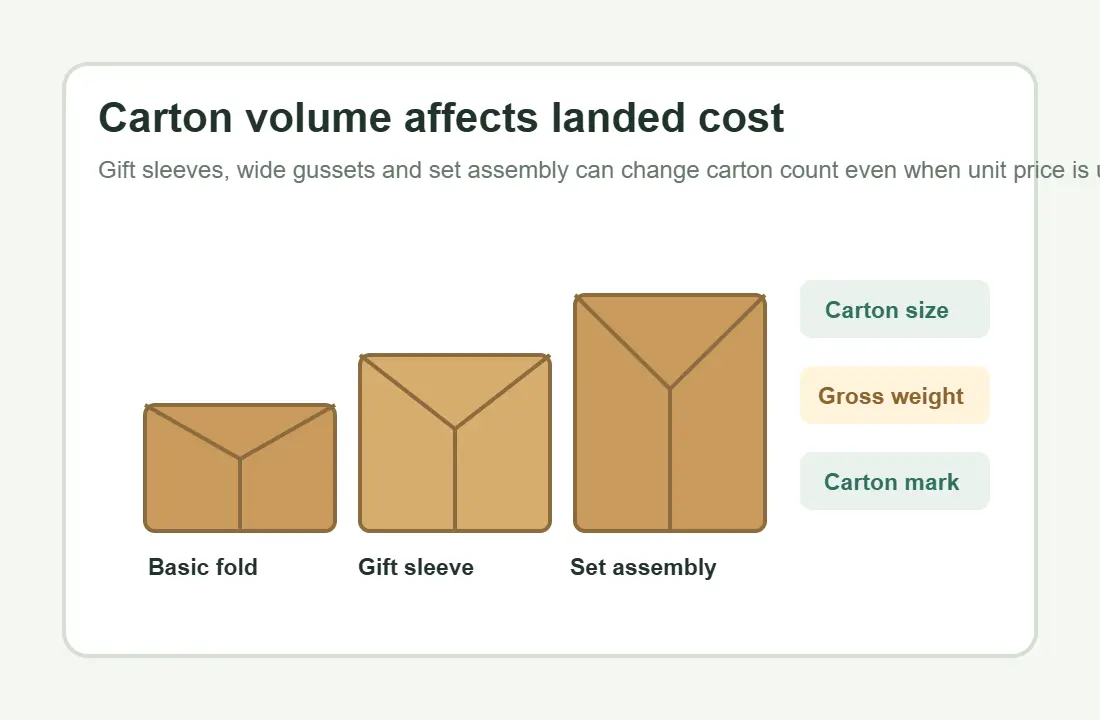
Supplier-side field note: A UK skincare brand asked for a heavyweight canvas tote with a small canvas cosmetic bag for a Christmas delivery window, and wanted to compare minimum-order pricing with sea freight instead of air freight. The export question was not only EXW, FOB, CIF or DDP; it was whether size, green color direction, pouch pairing, packing route, carton estimate and sea timing were locked early enough. If a buyer adds a paper box or changes packout after sample approval, carton count can increase sharply and the freight basis needs to be recalculated before the launch date is judged safe.
Common failure pattern
One European launch was delayed 10 days because the export term was not locked at RFQ stage. The buyer assumed DDP while the factory quoted EXW; mid-project rebooking pushed carton assembly and the shipment window past the retail launch date. Lesson: Incoterm choice belongs in the first quote, not in the shipping-ready email.
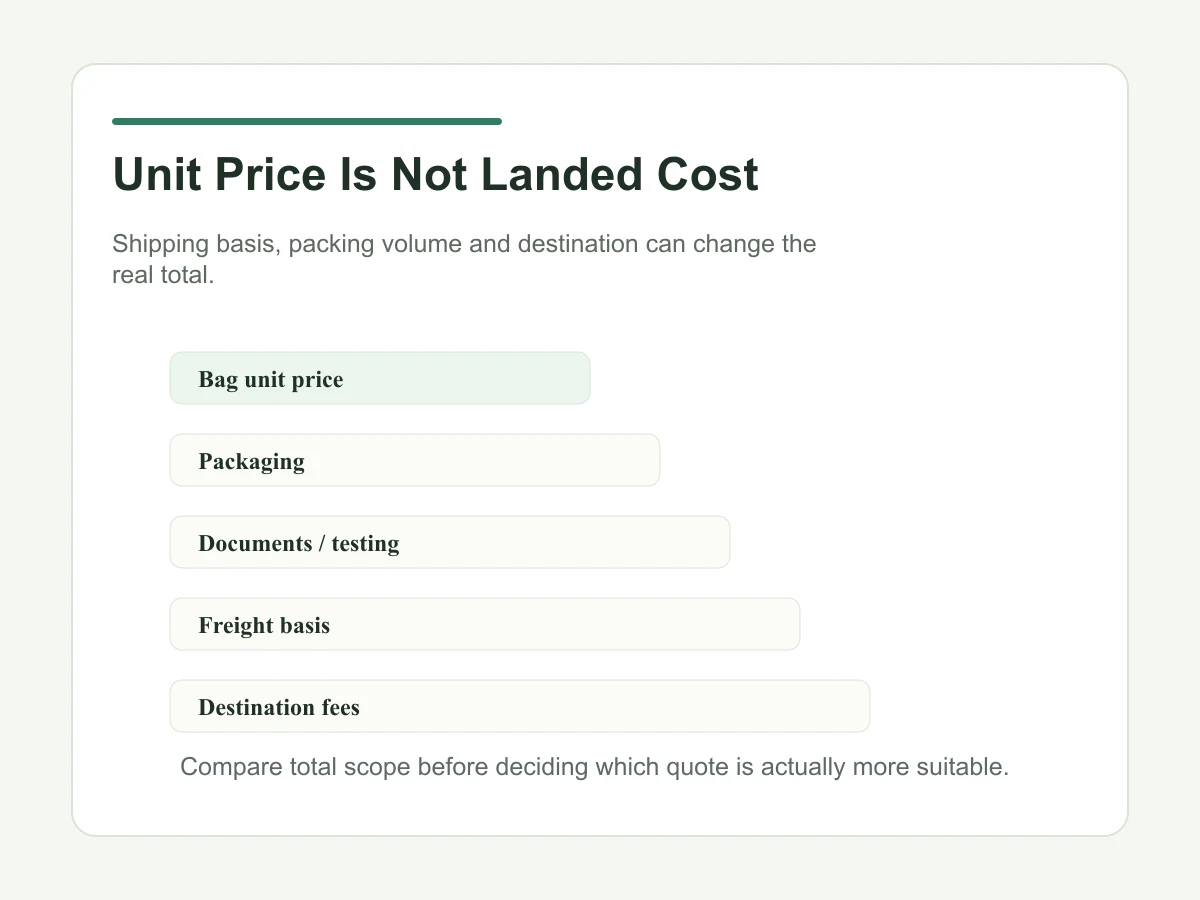
Europe buyers need to know whether a supplier quote includes factory handoff, port handoff, freight or destination delivery.
- EXW
- FOB
- CIF or DDP
How do sample timing and export basis interact?
Sample before bulk timing
Bulk lead time is more reliable after sample, artwork and packing route are approved.
Packing before freight basis
Packing route affects carton count, carton volume and whether a freight estimate needs revision.
Delivery before supplier score
Supplier comparison is stronger when every quote says which export responsibilities are included.
Compare Trade-Term Quote BasisView Related Buyer Guide
What makes a Europe supplier comparison practical?
If textile testing or document language enters supplier comparison, OEKO-TEX STANDARD 100 [3] provides useful context for testing-scope discussion. The project still needs tote-specific QC points and approval rules.
A practical comparison groups every supplier response by the same fields: product scope, sample route, bulk lead time after approval, packaging inclusion, carton estimate stage, quote basis, export term and document support. Without those fields, the buyer may choose a supplier for price and discover the missing responsibility later.
Useful related Ecoicolortote routes include the main supporting route, the connected buyer guide and the broader route page.
Material, pouch, insert, box or carton changes may alter the freight estimate before shipment.
- sample route
- packing volume
- destination
When this Europe export guide fits
Best fit: Europe-based agencies, food brands, beauty brands, retail teams and private-label buyers preparing MOQ 500+ custom tote RFQs where sample timing, export support and trade term comparison affect supplier selection.
Less suitable: local one-piece requests, no-brand stock bags, buyers who only compare ex-factory unit price, or urgent projects that refuse sample approval and packing confirmation before bulk.
Anonymized Europe supplier-selection note
A UK skincare buyer planning a Christmas tote and cosmetic pouch set needed more than a trade-term label. The supplier had to review product size, green color direction, sea freight timing, carton assumptions and whether a paper box would be added, because packout changes can increase carton count and change the freight quote. That structure helps the buyer avoid comparing incomplete export quotes that look cheaper only because the packing route is not locked.
Related shipping note
This article supports the shipping terms guide and the sea-freight carton data guide. It does not replace either guide: its focus is the Europe buyer decision stage where sample timing and quote basis need to be compared before supplier selection.
FAQ
What export terms should Europe buyers ask custom tote suppliers to quote?
Ask the supplier to state whether the quote is EXW, FOB, CIF, DDP or another basis, and what cost and responsibility are included. A Europe buyer can compare suppliers better when each quote uses the same product scope, packing assumption, destination and trade-term basis rather than only a unit price. This keeps supplier comparison tied to the same sample, packing and delivery assumptions.
When should sample timing be discussed?
Discuss sample timing at the RFQ stage. A supplier needs final or draft artwork, material direction, size, packing route and document expectations before confirming the sample path. Bulk production timing becomes more reliable only after sample approval, final artwork and any packing route are locked. This keeps supplier comparison tied to the same sample, packing and delivery assumptions.
How does MOQ 500+ affect Europe export planning?
MOQ 500+ is the normal B2B planning point for Ecoicolortote custom tote projects. Export planning still depends on size, material, packing, carton data and destination. For Europe buyers, the quote also needs to state whether sample cost, production timing and trade terms are based on one version or multiple materials, logos or packing routes.
What details help compare EXW, FOB, CIF and DDP quotes?
Use the same product specification, quantity, packing route, carton estimate, destination country and timeline for every supplier. Then ask each supplier to state what is included under the term. EXW, FOB, CIF and DDP shift different responsibilities, so they cannot be judged as equal without context. This keeps supplier comparison tied to the same sample, packing and delivery assumptions.
Can a supplier give a final freight cost before sample approval?
A supplier can provide a planning estimate when size and packing assumptions are available, but final freight cost may change after sample approval, carton data, packout method and destination details are confirmed. If the project includes inserts, boxes, pouches or retail packing, the freight estimate needs extra caution. This keeps supplier comparison tied to the same sample, packing and delivery assumptions.
How is this different from the sea freight carton data guide?
The sea freight carton guide focuses on carton size, packing ratio and freight-scope data. This article focuses on Europe supplier selection: sample timing, trade terms, export support and quote comparison before a buyer chooses a manufacturing partner. They support different steps of the same sourcing path. This keeps supplier comparison tied to the same sample, packing and delivery assumptions.
Who should use this guide?
Use this guide if you are a Europe-based agency, brand, retailer or private-label buyer planning MOQ 500+ custom tote bags and comparing suppliers by sample timing, export terms and production support. It is not intended for personal gifts, one-piece orders or price-only sourcing without sample approval. This keeps supplier comparison tied to the same sample, packing and delivery assumptions.
Sources
About the Author
 | Zoe Yu is B2B Sales Manager at Ecoicolortote, supporting overseas brand buyers with custom tote bag RFQs, material route review, logo execution, sampling, packing and bulk production coordination. |
Check Sample and Bulk TimingView Related Buyer Guide