Zoe Yu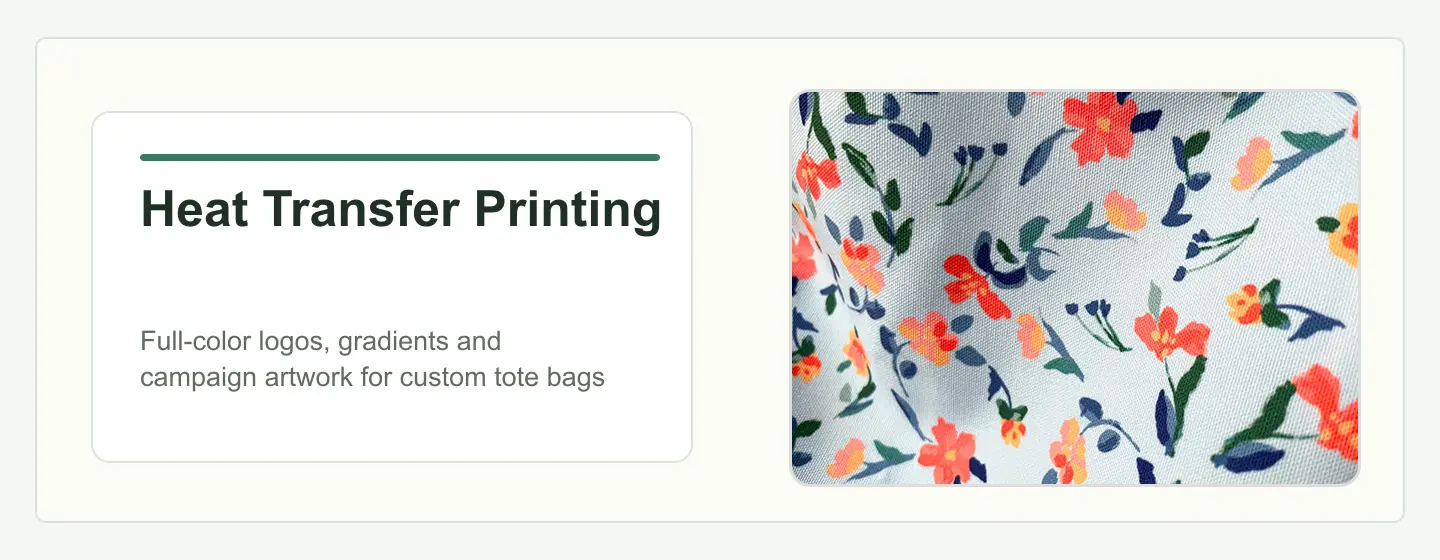
Heat transfer printing is sometimes misunderstood as a low-end sticker method. From our factory side, that is too simple. For custom tote bags, heat transfer can be a practical logo and artwork method when a buyer needs many colors, gradients, photo-style graphics or seasonal campaign artwork that would be expensive or difficult to separate for screen printing.
It is not the right answer for every project. The material surface, artwork file, hand feel expectation, bonding quality, sample confirmation and bulk standard all need to be checked before production. For beauty GWP, DTC retail, hotel welcome totes, resort campaign bags and retail launch gifts, the decision should be made around the artwork and use case, not only the process name.
Buyer Summary
- Best for: beauty GWP, DTC, retail, hotel, airline, resort and brand event buyers using many colors, gradients, photo-style details or seasonal campaign graphics on custom tote bags from 500 pcs per style.
- Main decision: compare heat transfer with screen printing and embroidery by artwork complexity, material surface, hand feel, sample result and launch timing.
- Factory-side note: rPET and smoother surfaces are often more friendly for full-color artwork, while textured cotton or canvas may need closer sample checking.
- What to prepare: editable artwork, Pantone references, material direction, logo size, placement, quantity, packaging needs, sample deadline and launch timeline.
Best fit for this heat transfer printing guide
This guide is best for brand buyers who already have campaign artwork, a logo direction or a product launch window, and need to decide whether heat transfer is the right logo method before sampling.
The strongest fit is a buyer sourcing custom tote bags from MOQ 500 pcs per style for beauty GWP, DTC merchandise, retail promotion, hotel welcome programs, airline gifts, resort campaigns or brand events. It is especially useful when the artwork has many colors, gradients, soft shadows, illustration details or photo-style graphics.
If the project only needs a one-color logo on a basic tote, screen printing may be simpler. If the project wants a small premium textured logo, embroidery, woven label, patch or metal plate may be stronger. Heat transfer should be considered when the artwork complexity justifies the process.
What is heat transfer printing for custom tote bags?
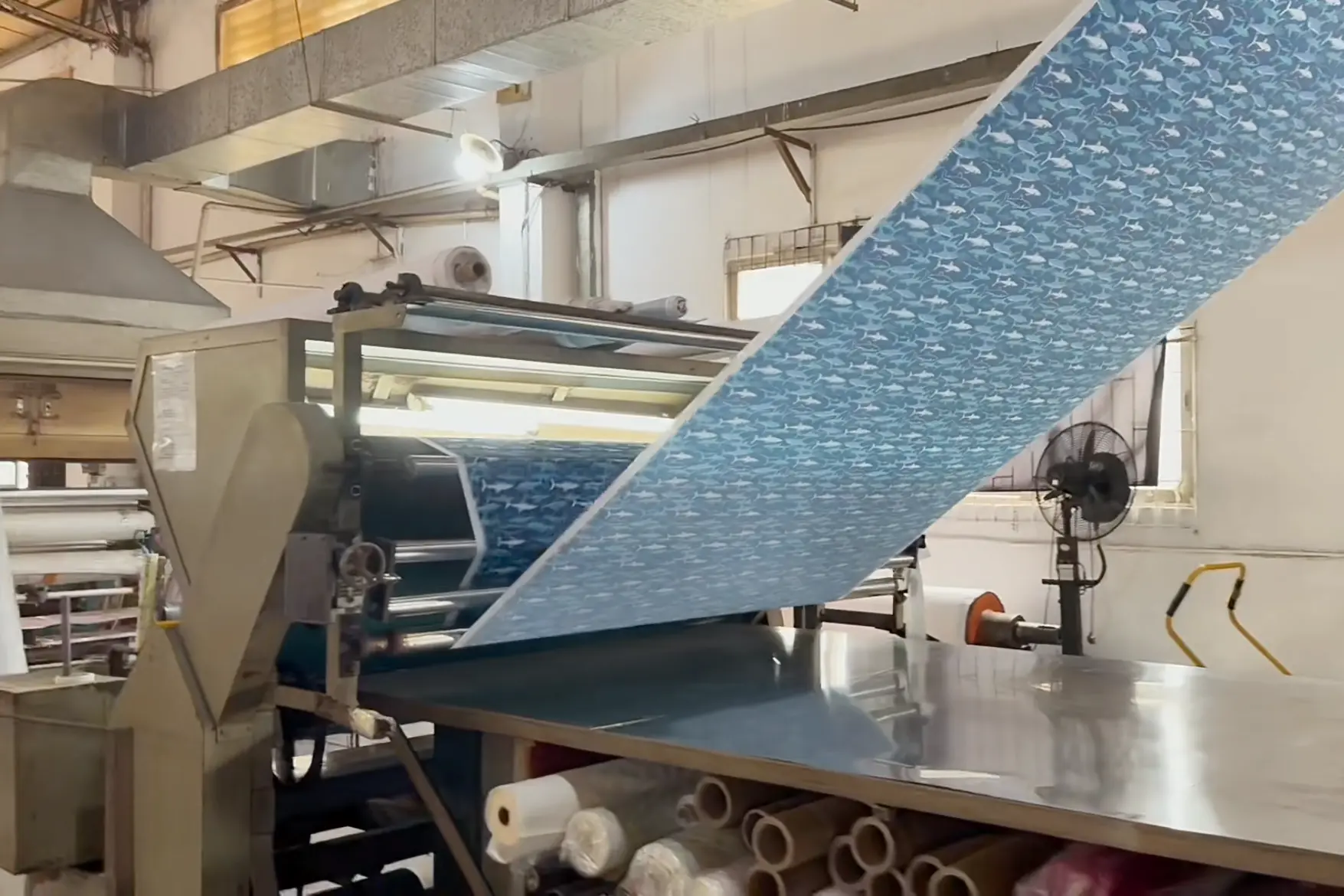
Heat transfer printing applies a prepared graphic onto the tote bag surface using heat, pressure and transfer media. It is useful when the artwork has many colors, gradients or detailed campaign graphics that are difficult to reproduce with simple screen printing.
For a buyer, the most important point is not the technical label. The real question is whether the final tote should show a simple one-color logo, a textured logo, or a complex full-color artwork. Heat transfer belongs in the discussion when the artwork is too colorful or too detailed for a simple logo process.
Because heat and pressure are involved, material behavior matters. Textile testing organizations such as AATCC1 publish test methods related to textile performance, which is one reason sample confirmation is important when heat is part of the process.
When should brand buyers use heat transfer printing?
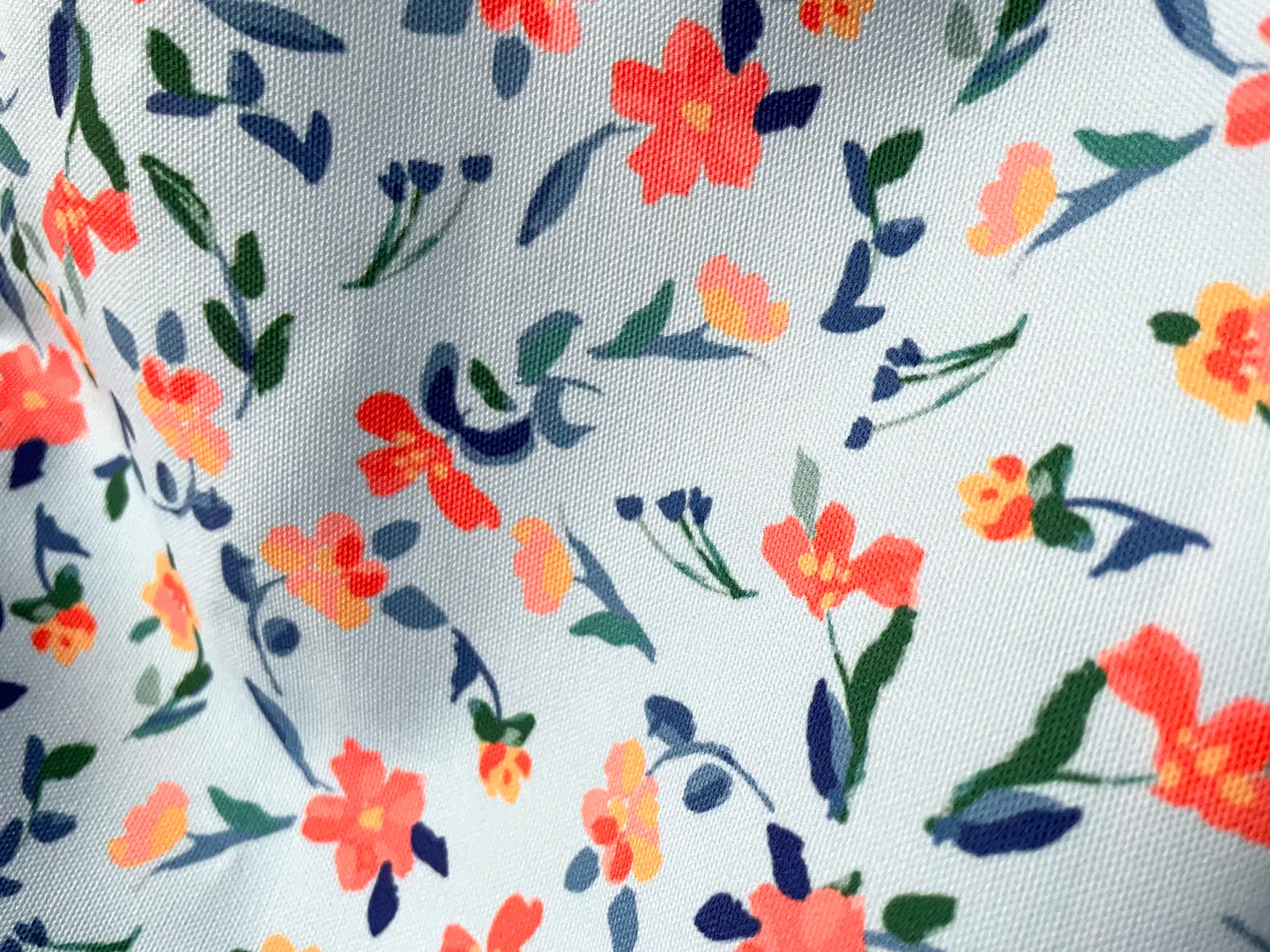
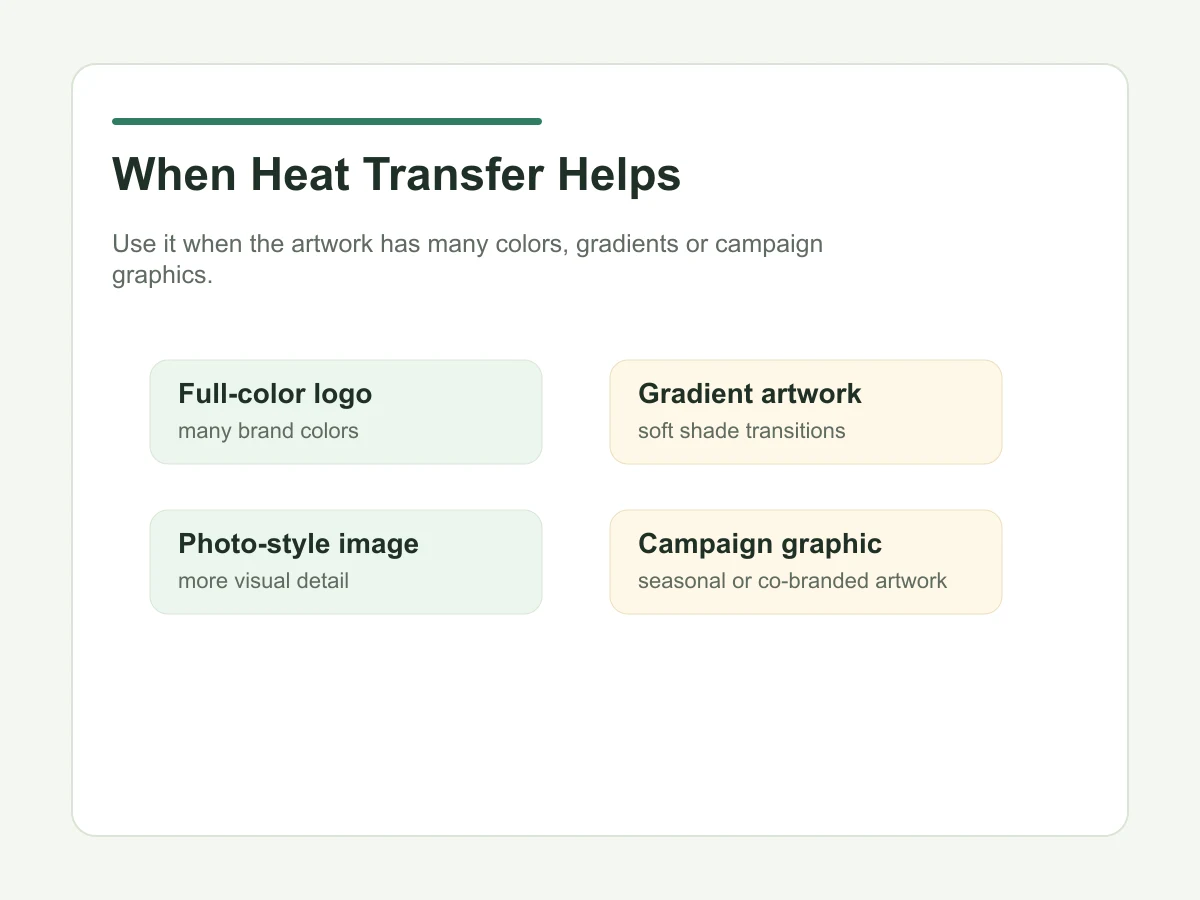
Brand buyers should consider heat transfer for multi-color logos, gradients, photo-style artwork, complex illustrations and campaign graphics. It is especially useful when screen printing would require many colors or when embroidery cannot reproduce the visual detail.
Beauty and wellness brands often use seasonal colors, limited-edition graphics or co-branded artwork. If the artwork has shadows, soft transitions or many small color changes, heat transfer can be easier to evaluate than separating every color for screen printing.
For GWP projects, the process can also help when the tote needs to match a gift box, launch theme or campaign artwork. Pantone color fundamentals2 are useful when brand colors are important, but final approval should be based on the physical sample because color spaces and materials do not behave the same way.
Which tote bag materials work with heat transfer?
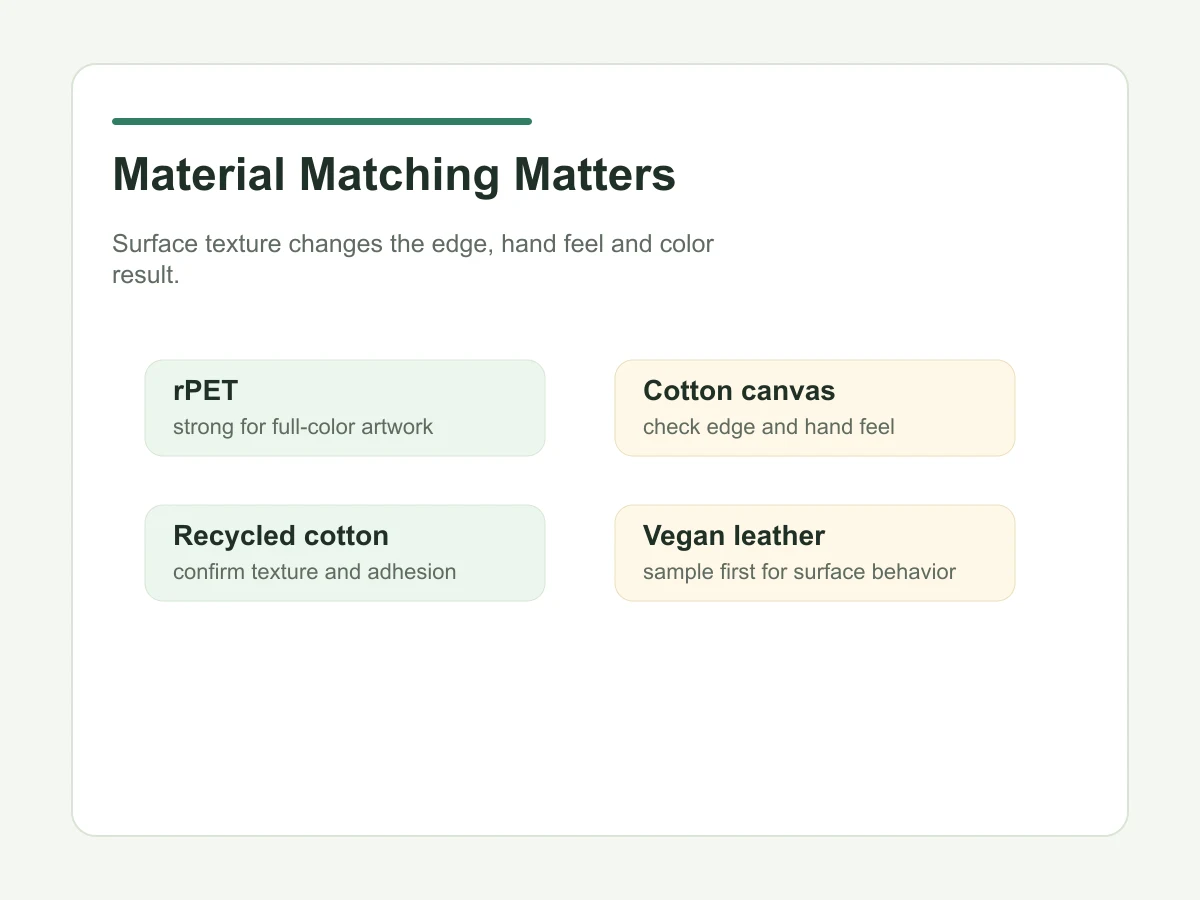
Heat transfer can work on several tote materials, but the final result depends on surface texture, thickness, flexibility and heat behavior. rPET and smoother surfaces are often easier for full-color artwork; rougher cotton or canvas surfaces need closer sample review.
rPET is often a strong direction for full-color campaign artwork because it can support colorful print-heavy designs and has many surface options. Cotton canvas, recycled cotton and organic cotton can also be considered, but the hand feel and transfer edge may be more visible depending on the fabric texture.
If a material is very rough, very soft, too thin or has a strong surface texture, we would suggest a sample first. A process that looks clean on one fabric can feel different on another fabric. If the project uses recycled material or environmental wording, the material and claim should also be supported properly. Global Recycled Standard information3 and the FTC Green Guides summary4 are useful references for recycled-content and environmental claim discussions.
How does heat transfer compare with screen printing and embroidery?
Screen printing is usually better for simple color-block artwork, embroidery is stronger for small textured logos, and heat transfer is useful for multi-color, gradient or photo-style artwork. The right method depends on artwork, material, budget and brand effect.
If a client asks us to choose between heat transfer and screen printing, we first look at the artwork. A one- or two-color logo with clear edges may be suitable for screen printing. A logo with many colors, gradients or a full campaign illustration may be more suitable for heat transfer.
If the choice is between heat transfer and embroidery, the question is usually texture versus detail. Embroidery gives a more tactile logo feel, but it has limits with very small text, complex gradients and photo-like graphics. Heat transfer can carry more image detail, but the buyer should confirm hand feel and sample performance.
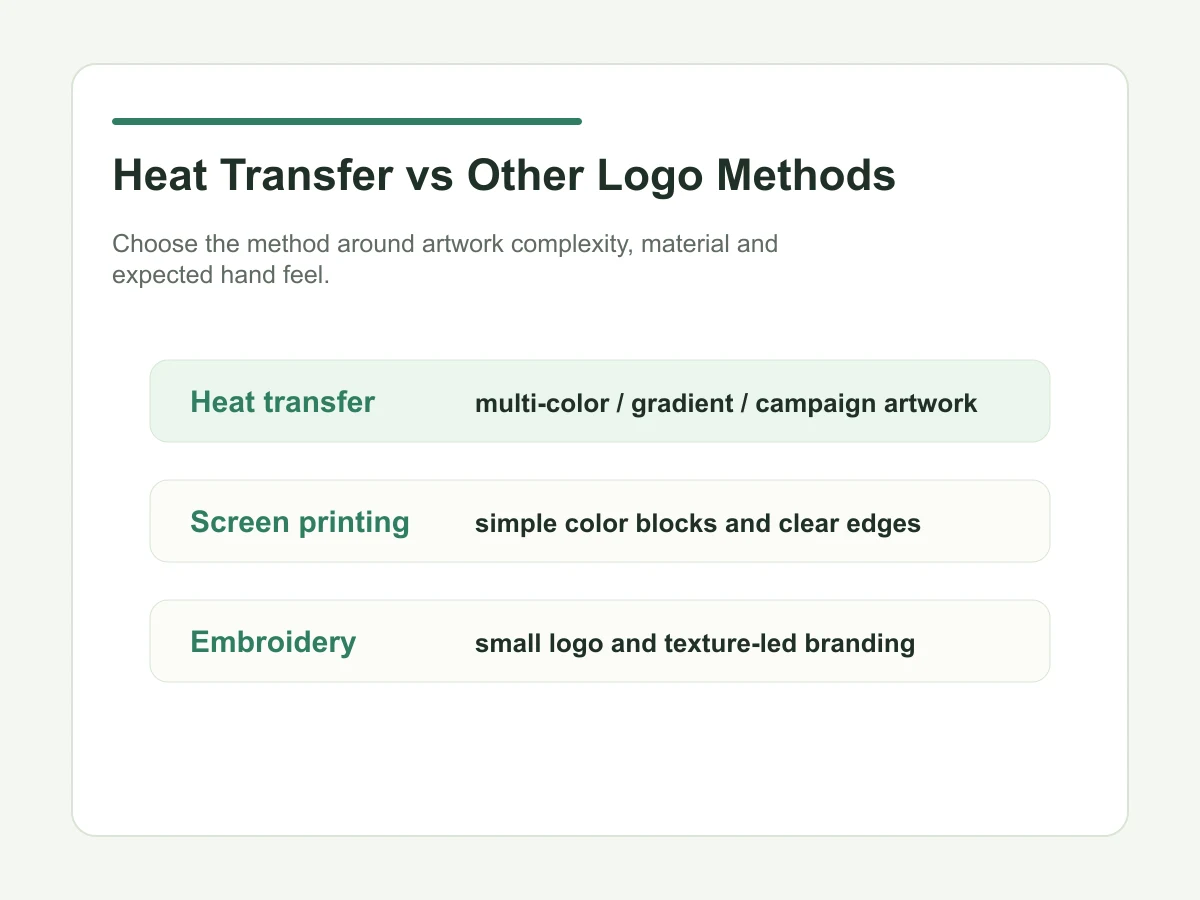
| Decision factor | Heat transfer | Screen printing | Embroidery |
|---|---|---|---|
| Best for | Full-color artwork, gradients, campaign graphics | Simple logos and solid color blocks | Small premium logos and textured branding |
| Color count | Strong for many colors | Cost rises with more colors | Limited by thread colors and stitch detail |
| Gradient / photo effect | Usually suitable | Usually less suitable unless simplified | Not the natural choice |
| Hand feel | Must be checked by sample, especially on larger artwork | Usually flatter and more ink-like | Raised and tactile |
| Small text | Depends on file quality and transfer detail | Can work if size and edge are clear | Can lose clarity if too small |
| Sample risk | Hand feel, edge and bonding must be confirmed | Color and edge need checking | Wrinkle, backing and stitch density need checking |
| Buyer question | Will the graphic feel right on this material? | How many colors and screens are involved? | Will the logo still be clear after stitching? |
| Artwork type | Often suitable method | Why | Watch-out |
|---|---|---|---|
| One-color logo | Screen printing | Clear and efficient for simple artwork | Check ink color and edge |
| Small premium logo | Embroidery / woven label / metal plate | Adds texture or hardware detail | Small text may lose clarity |
| Gradient or many colors | Heat transfer | Avoids many screen setups | Confirm hand feel and edge |
| Photo-style campaign graphic | Heat transfer / digital print route | Supports more image detail | Sample on the actual material |
| Full-surface seasonal artwork | Material and print method review needed | Depends on tote material and construction | Do not approve only from screen mockup |
What artwork files and color details should buyers provide?
For heat transfer projects, buyers should provide editable artwork when possible, such as AI, EPS or editable PDF, plus Pantone references for key brand colors. High-resolution images can help, but low-resolution JPG files often reduce clarity.
The file quality matters because heat transfer often carries more visual detail. If the file is low resolution, the final print can look soft or unclear. If the artwork includes brand colors, we suggest providing Pantone references and approving a sample instead of relying only on a screen preview.
For files that include SVG artwork or web-based vector assets, the W3C SVG specification5 is a useful reference for understanding scalable vector graphics as a file format category. In production, however, the final file still needs factory review because the process, material and artwork complexity all interact.
What quality risks should buyers confirm before sampling?
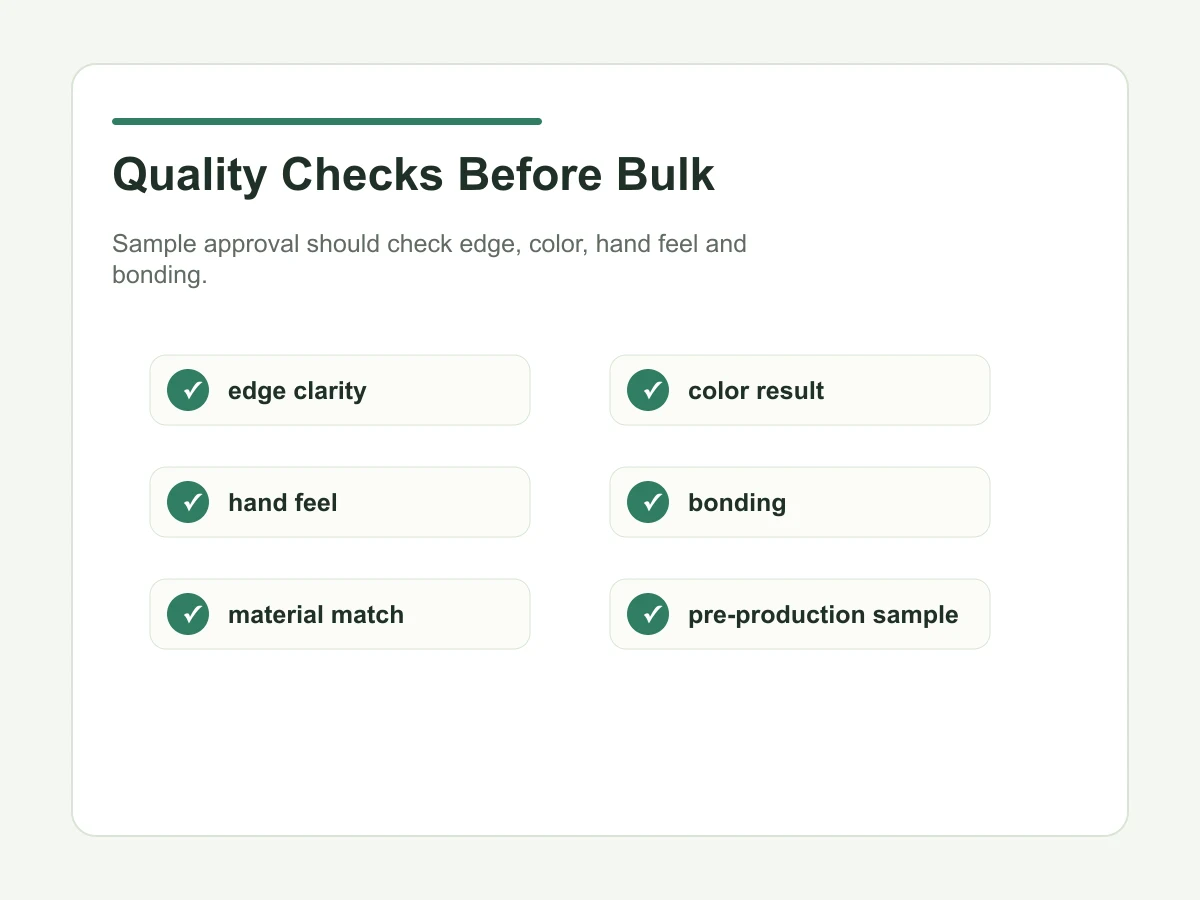
The main heat transfer risks are hand feel, edge visibility, color result, bonding, cracking, fading and material mismatch. These risks are controlled through artwork review, material matching, physical samples and pre-production sample approval.
Buyers often worry that heat transfer will feel hard, peel, crack or look like a patch. Those risks depend on the transfer type, film quality, material surface, pressing conditions and final use. That is why we do not recommend approving only from a computer mockup.
From our factory side, we check the sample for color, edge cleanliness, surface feel and bonding. If the tote will be used for a retail or repeated-use project, the buyer can also request relevant testing based on market needs. OEKO-TEX STANDARD 1006 is a common textile safety reference when harmful substance testing matters, but it should not be confused with a recycled-material claim.
How does heat transfer affect MOQ, samples and timeline?
Our MOQ starts from 500 pcs per style. Heat transfer is usually treated as one logo process, but the project timeline can change if the tote also includes woven labels, inner pockets, special packaging, material customization or multiple sample revisions.
Sample timing is confirmed after the material, construction, logo method, artwork, packaging and approval scope are clear; the working schedule also depends on revision speed and current capacity.
Bulk production timing should be confirmed after sample approval. It depends on order quantity, material availability, color customization, packaging and production complexity. If the artwork is central to a launch date, we suggest confirming the heat-transfer sample as early as possible.
What mistakes should buyers avoid?
The most common mistakes are sending low-resolution artwork, choosing a process before checking the design, approving only a computer mockup, ignoring material surface, and leaving hand feel or durability expectations until after sampling.
One common issue is insisting on screen printing for a complicated multi-color artwork because the buyer is familiar with screen printing. Sometimes that is possible, but it may become expensive or less suitable. In those cases, heat transfer can be a practical Plan B.
Another mistake is expecting the artwork to look exactly the same on every material. A graphic on rPET, cotton canvas and vegan leather may show different color, edge and surface feel. The right solution is not guessing. It is reviewing the file, choosing a suitable material direction and confirming the physical sample.
What should buyers confirm before sampling?
Before sampling, buyers should confirm artwork file quality, Pantone or approved colors, material direction, logo size and placement, hand feel expectation, packaging needs, document requirements and launch timeline.
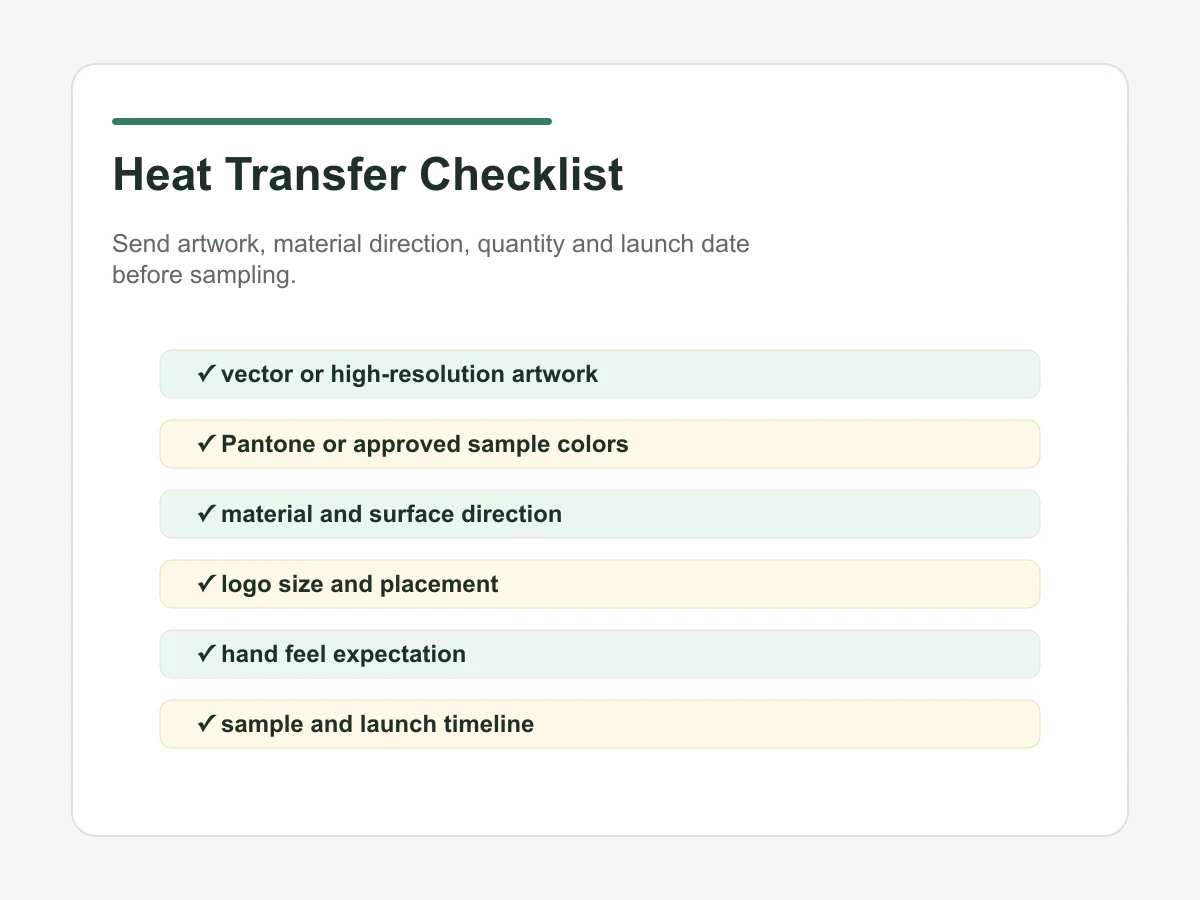
| Check item | What to send | Why it matters | Risk if missing |
|---|---|---|---|
| Artwork file | AI, EPS, editable PDF or high-resolution artwork | Controls clarity and edge detail | Soft or unclear print |
| Color reference | Pantone or approved physical color | Helps align brand color | Unexpected color difference |
| Material direction | rPET, cotton, recycled cotton or other surface | Changes hand feel and bonding result | Wrong process choice |
| Logo size | Exact width, height and position | Affects cost and final look | Artwork too large or too stiff |
| Use case | GWP, retail, hotel, airline, resort, event or seasonal campaign | Changes durability and packaging needs | Wrong sampling priority |
| Launch date | Target date and shipping destination | Helps plan sample and bulk timing | Rushed approval or costly shipping |
What still needs RFQ confirmation?
Heat transfer guidance can help a buyer decide whether this method belongs in the logo process discussion. Final hand feel, color result, bonding and bulk standard still need actual artwork, material and sample review.
From our factory side, heat transfer should not be approved only because it looks suitable in a guide. The RFQ stage still needs the actual logo file, material surface, logo size, expected use, packaging requirement and launch date. If the buyer has a strict brand color or retail requirement, the physical sample and pre-production sample become the real standard.
| RFQ check | Buyer should provide | What it confirms | What it does not prove yet |
|---|---|---|---|
| Artwork file | AI, EPS, editable PDF or high-resolution image | Whether the artwork can be prepared for transfer | Final color and hand feel on the chosen material |
| Material surface | rPET, cotton canvas, recycled cotton or other material direction | Whether heat transfer is a reasonable process option | Bulk consistency before sample approval |
| Logo size | Exact width, height and placement | Whether the artwork area may feel too large or stiff | Final visual balance without a sample |
| Use case | GWP, retail, hotel, airline, resort, event or seasonal campaign | Durability and packaging priorities | Market-specific testing needs unless requested |
| Launch date | Target delivery date and destination | Whether sampling and bulk production timing is realistic | Shipping delay risk outside production control |
Less suitable fit for heat transfer tote projects
Ecoicolortote is less suitable for single-piece gifts, no-brand personal projects, lowest-price-only RFQs or full-color artwork projects that skip physical sample approval.
- Orders below 500 pcs per style without an existing brand, campaign or launch context.
- Buyers who only ask for the lowest logo cost without providing usable artwork, material direction or quantity.
- Projects that expect full-color artwork but skip physical sample approval for hand feel, edge and bonding.
- Buyers who approve only a computer mockup and refuse pre-production sample confirmation for brand-sensitive orders.
FAQ: Heat transfer printing for custom tote bags
Is heat transfer printing good for custom tote bags?
Heat transfer printing can be a good method for custom tote bags when the artwork has many colors, gradients, photo-style images or campaign graphics. It is less useful for a simple one-color logo that can be handled by screen printing. Buyers should confirm the material surface, hand feel, edge result, bonding and physical sample quality before approving bulk production.
Is heat transfer better than screen printing?
Heat transfer is not automatically better than screen printing. It is often more suitable for complex full-color artwork, while screen printing is usually more suitable for simple color-block logos and larger repeat orders with limited colors. The better choice depends on artwork complexity, material surface, target hand feel, budget, quantity, sample result and launch timing.
What files are needed for heat transfer tote bag artwork?
Editable artwork such as AI, EPS or editable PDF is preferred for heat transfer tote bag projects. High-resolution image files may help for photo-style artwork, but low-resolution JPG or PNG files can reduce clarity. Buyers should also send Pantone references, final logo size, placement direction and any brand color approval rules before sampling begins.
Which tote materials work best with heat transfer printing?
rPET and smoother tote materials are often easier for full-color heat transfer artwork because the surface can support cleaner graphic detail. Cotton, recycled cotton and canvas may still work, but texture, thickness and softness can change edge visibility and hand feel. The safest choice is to sample the artwork on the actual material before bulk approval.
Will heat transfer printing peel or crack on tote bags?
Peeling or cracking risk depends on transfer quality, material surface, heat setting, pressure, artwork size, use conditions and washing expectations. A good factory should check bonding, edge cleanliness and surface feel during sample approval. For retail or repeated-use projects, buyers can request suitable performance testing or inspection requirements before bulk production is released.
Does heat transfer affect custom tote bag cost or timeline?
Heat transfer can affect cost and timeline when the artwork is large, color-sensitive, detailed, or needs multiple sample rounds. It may be efficient compared with many screen-printing color separations, but the project still needs artwork preparation, material matching and sample approval. Timing also changes if packaging, labels, pockets or other logo processes are added.
What should buyers send before requesting a heat transfer tote quote?
Buyers should send the use case, quantity, tote size, material direction, editable artwork, Pantone references, logo size, placement, packaging needs, document requirements, sample deadline, launch date and shipping destination. If the artwork is not final, send the best available file and explain the campaign goal so the factory can judge feasibility before sampling.
Send your artwork file, Pantone references, material direction, logo size, placement, target quantity, packaging needs, sample deadline and launch date. Ecoicolortote can help compare heat transfer, screen printing and embroidery before sampling. Contact Ecoicolortote.