Zoe Yu
A custom tote bag tech pack is not only a design file. For brand buyers, it is the shared standard that aligns dimensions, material, artwork, label files, packing notes, tolerances, sample approval records and bulk production control before small mistakes become expensive.
TL;DR: A custom tote bag tech pack turns a tote idea into a shared standard for quotation, sampling, packaging, documents and bulk production. Buyers should define use case, quantity, dimensions, material, artwork, logo method, label files, packing notes, tolerances, document scope, sample versions and approval owner before bulk planning. A stronger tech pack reduces repeated quote changes, sample rework, packaging mistakes and unclear QC standards.
Many buyers start with reference photos, a logo and a rough idea. That is enough for early discussion, but it is not enough for accurate sampling or bulk production. The more clearly the tech pack defines size, material, logo method, packaging, labels, documents and approval standards, the less time is lost in repeated quotation and sample changes.
Ecoicolortote is a better fit for MOQ 500+ brand projects where the buyer can share a real use case, order quantity, size direction, logo file, material preference, packaging route and launch timeline. Buyers can review our customization options, private label totes and GWP brand totes before building the tech pack.
Buyer Summary
- Best for: brand teams planning custom tote bags for GWP, retail, hotel welcome gifts, campaign merchandise or private label SKUs from 500 pcs per style.
- Main decision: whether the project details are clear enough for quotation, sampling, packaging, document planning and bulk production control.
- Factory-side note: a tech pack reduces repeated quote changes by aligning dimensions, materials, artwork, label files, packing notes, tolerances and approval records before sampling.
- What to prepare: use case, quantity, dimensions, material direction, logo file, packaging needs, label files, document scope, sample approval owner and launch date.
Best fit for this tech pack guide
This guide is best for MOQ 500+ brand projects where the tote bag needs a clear quotation, sample, packaging, document and bulk production standard before approval.
This guide is best for brand teams planning MOQ 500+ custom tote bags for GWP, retail, hotel welcome gifts, campaign merchandise, private label SKUs or recurring promotional programs. It is especially useful when a buyer already has reference photos, artwork, a rough size idea or packaging needs, but the project is not yet detailed enough for accurate sampling and bulk production.
The strongest fit is a sourcing, marketing or product team that needs one shared record for dimensions, material, logo process, labels, packaging, documents, sample revisions, approval ownership, launch timing and final QC comparison before the factory prepares the production standard.
What should buyers confirm before sourcing a custom tote bag tech pack?
Buyers should confirm use case, quantity, dimensions, material direction, artwork files, logo method, label files, packing notes, tolerances, document scope, sample approval records and launch timeline. A tech pack is more detailed than a simple RFQ brief because it becomes the shared standard for sampling and bulk production.
An RFQ brief helps a supplier understand whether the project is possible and how to estimate a quote. A tech pack goes further. It records what the bag should become: size, structure, material, logo process, colors, labels, packaging, document requirements, tolerance notes and approval history.
If a buyer only sends a product photo and logo, we can still start the conversation. But before accurate sample development, the key details must be confirmed. Otherwise, the quote may change, the sample may need repeated revision, or the bulk production team may not have one clear standard.
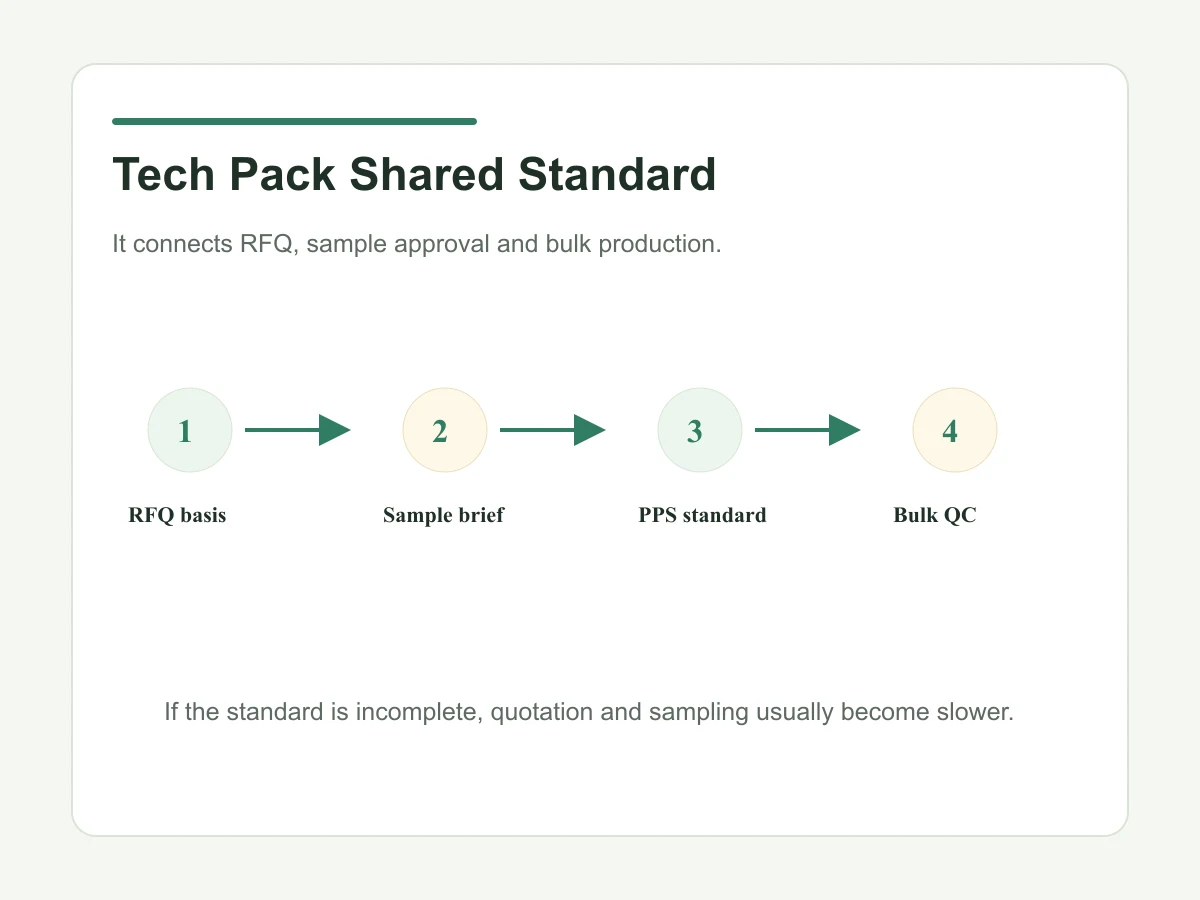
This tech pack guide explains how to turn project details into a production standard. The RFQ checklist helps buyers prepare quote information, the manufacturing process guide explains how production flows, and the sample approval guide explains how the approved physical sample becomes the bulk standard.
If your team is still preparing the first inquiry, start with the custom tote bag RFQ checklist. If your team wants to understand production stages, use the custom tote bag manufacturing process guide. If the main risk is sample sign-off, review sample approval mistakes.
This page sits between those topics. It shows what fields should be written in the tech pack so quotation, sampling, packaging, labels, document scope and bulk inspection are working from the same record.
What basic project information should be included?
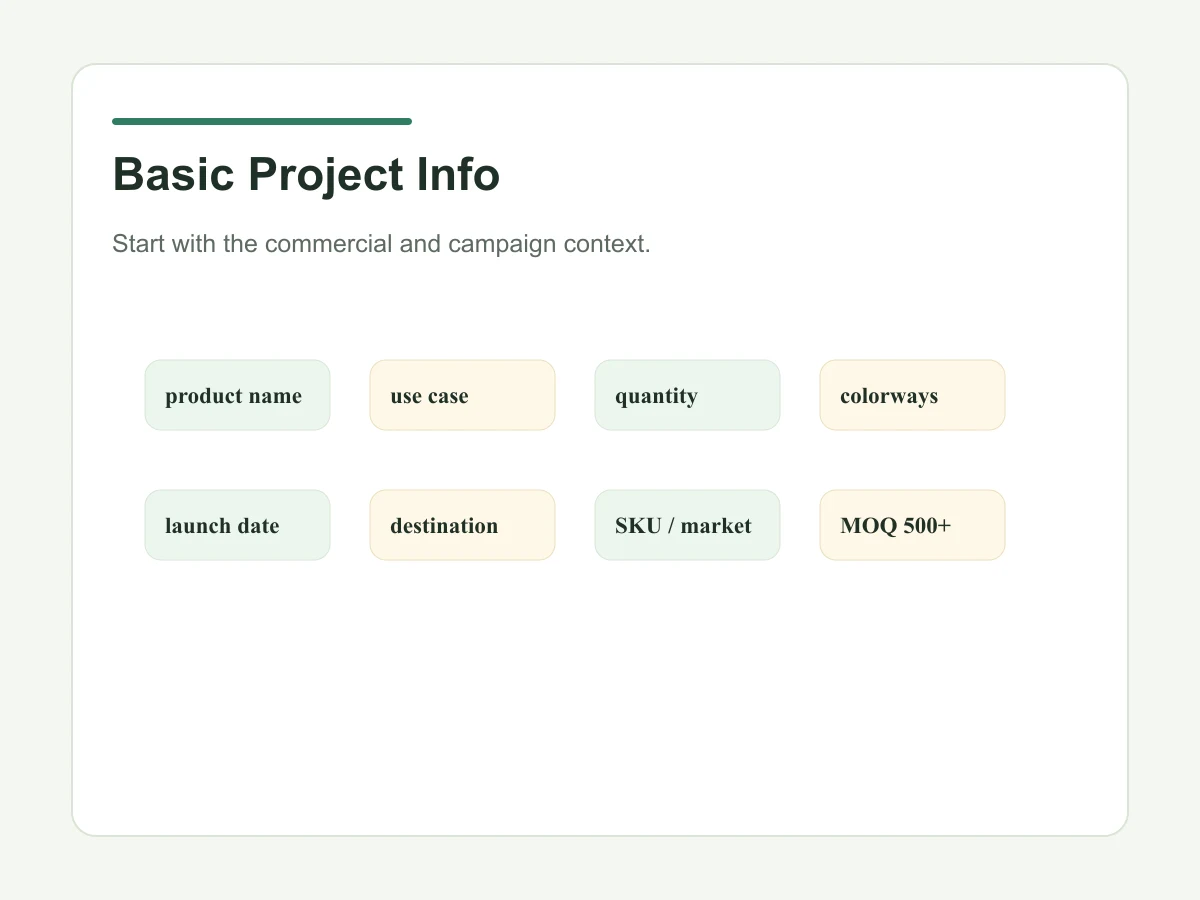
Basic project information should include product name, use case, customer type, quantity, colorways, SKU or market, launch date, destination and commercial requirements such as MOQ from 500 pcs per style.
Use case matters. A beauty GWP tote, retail SKU, hotel welcome tote and event tote may use different materials, packaging and approval logic. If the project is seasonal, the campaign or launch date should be included early. If there are multiple colors or SKUs, list them separately because each version may have different logo, label, barcode, packaging or market requirements.
| Project field | What to include | Why it matters |
|---|---|---|
| Use case | GWP, retail, hotel, event, campaign or private label SKU | Sets quality, packaging and approval logic. |
| Quantity | Total order quantity and version split | Affects MOQ, cost, material allocation and sample route. |
| Market or destination | Delivery country, retailer, property or event location | Supports label, document and carton planning. |
| Launch timing | Sample deadline, approval date and delivery window | Helps judge whether schedule is realistic. |
What dimensions, tolerances and construction details should be specified?
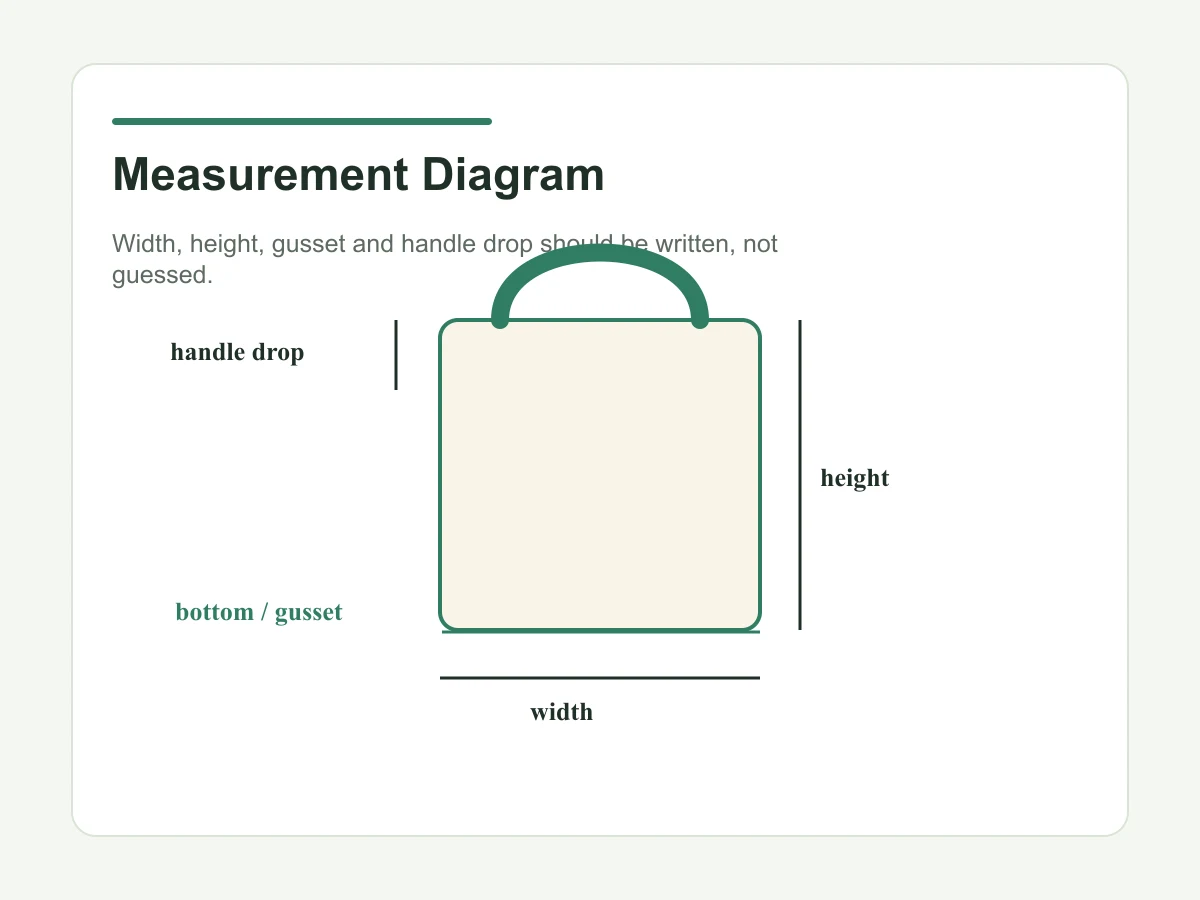
The tech pack should specify width, height, bottom gusset, side gusset, handle drop, strap length, pocket size, lining, zipper, magnet, inner pocket, bottom board, hardware, tolerance notes and any special construction details.
Dimensions should be written and shown visually where possible. For projects that need to hold skincare bottles, gift boxes, hotel items or retail products, the tech pack should also include the size of the products going inside the tote.
We have seen projects repeat sample changes because the buyer gave a size, but did not explain what needed to fit inside. If capacity is strict, sending the actual product or exact product dimensions early is much better than guessing from photos.
| Measurement field | What to include | Why it matters |
|---|---|---|
| Bag body | Width, height, bottom gusset and side gusset | Controls capacity, fabric use and carton volume. |
| Handle | Handle drop, strap length and strap width | Decides hand carry, arm carry or shoulder carry comfort. |
| Interior | Inner pocket, lining, zipper, magnet or bottom board size | Prevents structure changes after sampling starts. |
| Tolerance | Reasonable finished-size tolerance by material and construction | Defines what is acceptable during QC. |
| Product fit | Product, gift box or bottle dimensions if capacity is strict | Confirms the tote can hold the real campaign items. |
What material details should be written?
Material details should include material name, composition, fabric weight, color, handfeel, surface type, recycled or organic direction, approved swatch and any document expectation connected to material claims.
Broad environmental material wording is not specific enough for a production standard. Recycled cotton blend and 100% recycled cotton should be separated. rPET should also be described more clearly, because rPET can appear as canvas-like fabric, satin-like surface, velvet, fleece or other textures.
If the buyer is not sure which material to use, we can recommend based on use case, budget direction, brand positioning, logo method and document needs. But once the sample enters approval, the tech pack should record the selected material clearly.
| Material field | What to write | Watch-out |
|---|---|---|
| Composition | rPET, recycled cotton blend, cotton canvas, organic cotton or other selected material | Similar names can mean different cost, feel and document scope. |
| Weight or structure | GSM, oz, thickness, lining or backing if needed | Weight and structure affect shape, sewing and quote accuracy. |
| Color | Pantone, approved swatch or nearest available material color | Small orders may use closest available material instead of custom dyeing. |
| Surface or handfeel | Canvas-like, satin-like, velvet, fleece, soft, structured or smooth | Photos cannot fully confirm handfeel. |
| Claim or file need | Recycled, organic, OEKO-TEX, FSC packaging or testing requirement | Claims must match material, supplier, factory and order scope. |
For recycled-content discussions, Global Recycled Standard1 can help buyers understand chain-of-custody concepts. The FTC Green Guides summary2 is useful for keeping environmental claims specific and supported.
What logo and artwork details should be included?
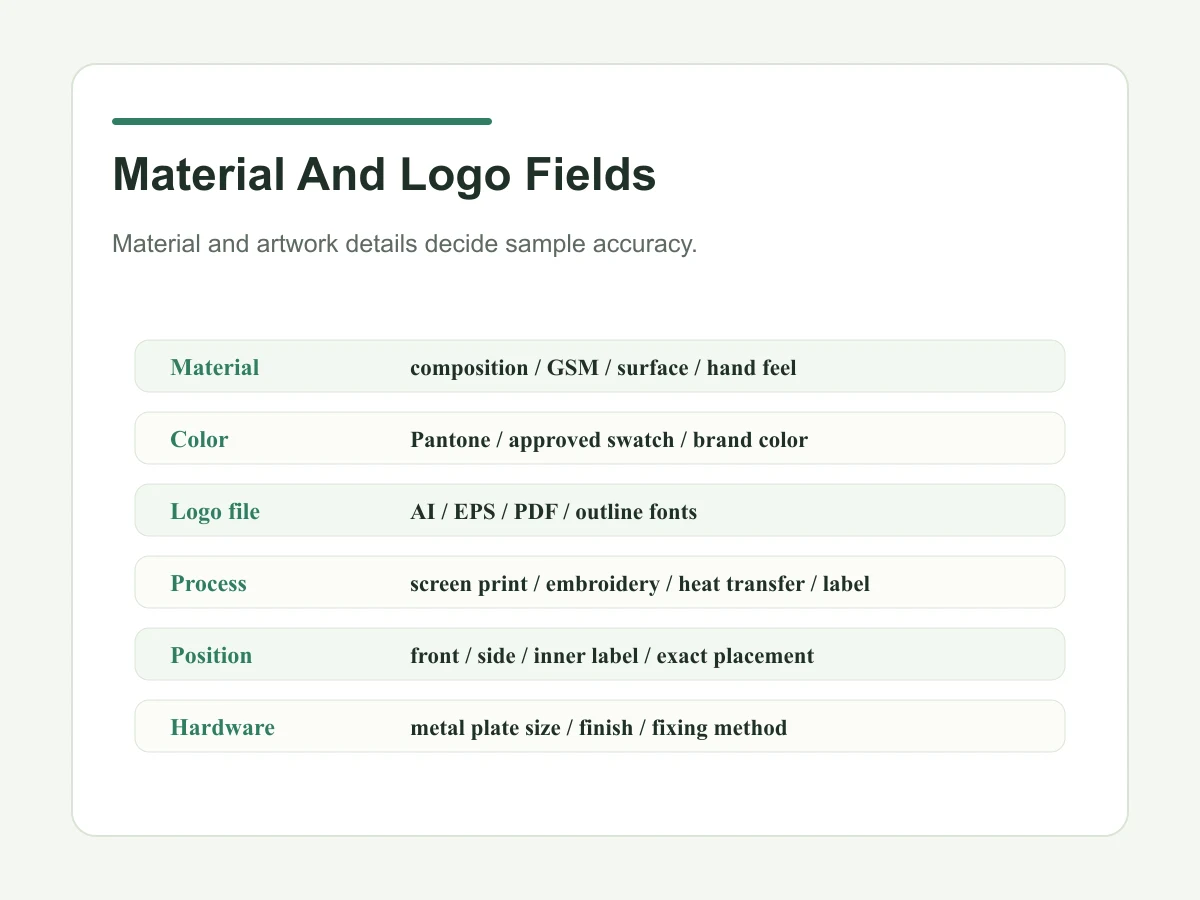
Logo details should include AI, EPS or editable PDF artwork, Pantone reference, logo size, position, process, color count, print side, small text, gradients, woven labels, patches, metal plates or debossing requirements.
Artwork files should be production-ready whenever possible. For logo files with live fonts, the artwork should be outlined or converted properly to reduce the risk of font replacement. Each logo process should be written clearly because screen print, embroidery, heat transfer, woven label, patch, metal plate and debossing require different assumptions.
For metal plates, the tech pack should include size, thickness, color, plating effect, fixing method and mold confirmation when applicable. For embroidery, buyers should record thread color, stitch area and small text limits. For heat transfer, buyers should record artwork area, finish and edge expectations. The logo file requirements guide can help prepare artwork before sampling.
What label files, packing notes and packaging details belong in the tech pack?
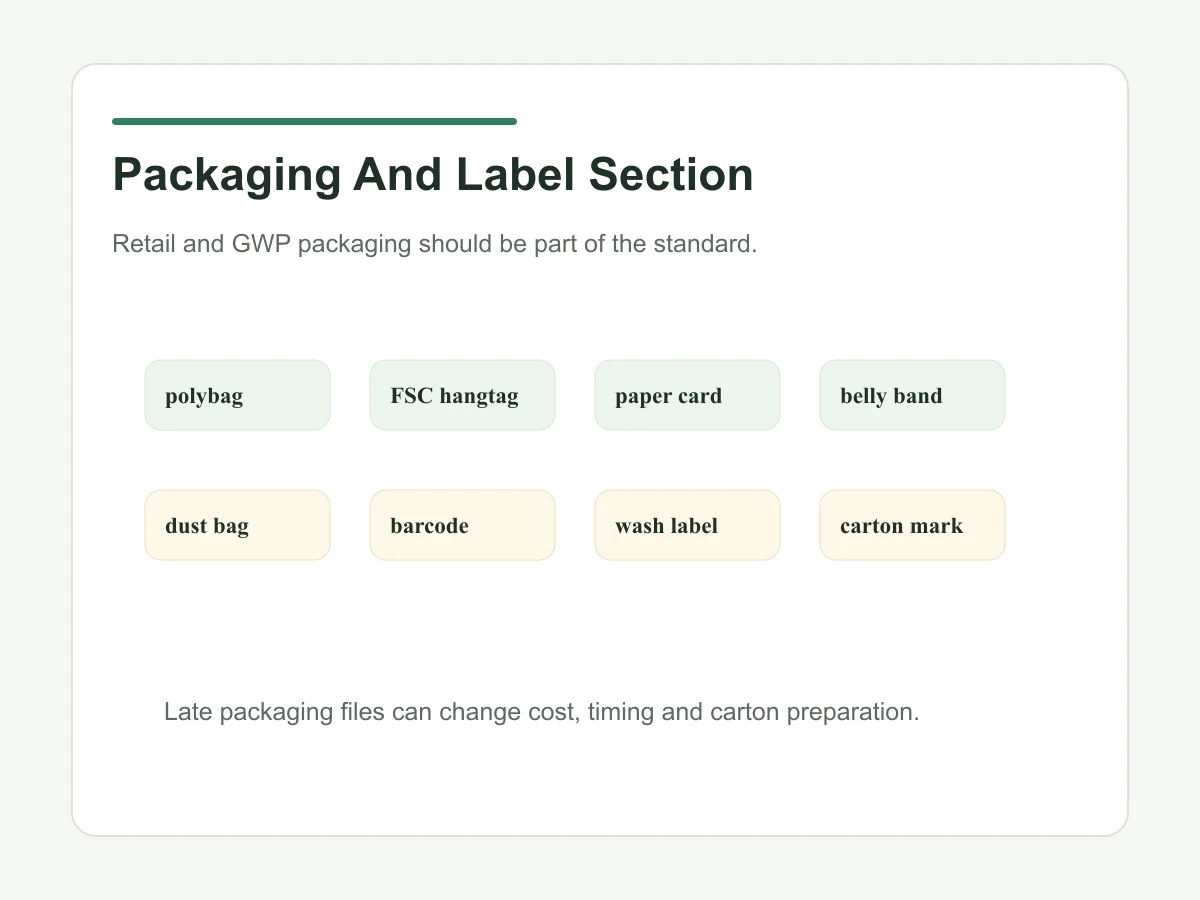
Packaging details should include polybag, recycled-content polybag, hangtag, paper card, belly band, dust bag, box, barcode, SKU label, wash label, composition label, country-of-origin label, carton mark and pack-out notes.
Packaging is often added too late. For GWP and retail projects, packaging files can affect cost, paper production, barcode accuracy, carton preparation and shipment timing. Small paper cards or hangtags may also have setup costs that matter at lower quantities.
For retail barcode and product identification requirements, GS1 General Specifications3 can help frame the discussion. FSC paper and packaging4 applies to paper packaging scope, such as paper cards, hangtags and cartons, not the tote fabric itself.
Which material or certification evidence should be checked?
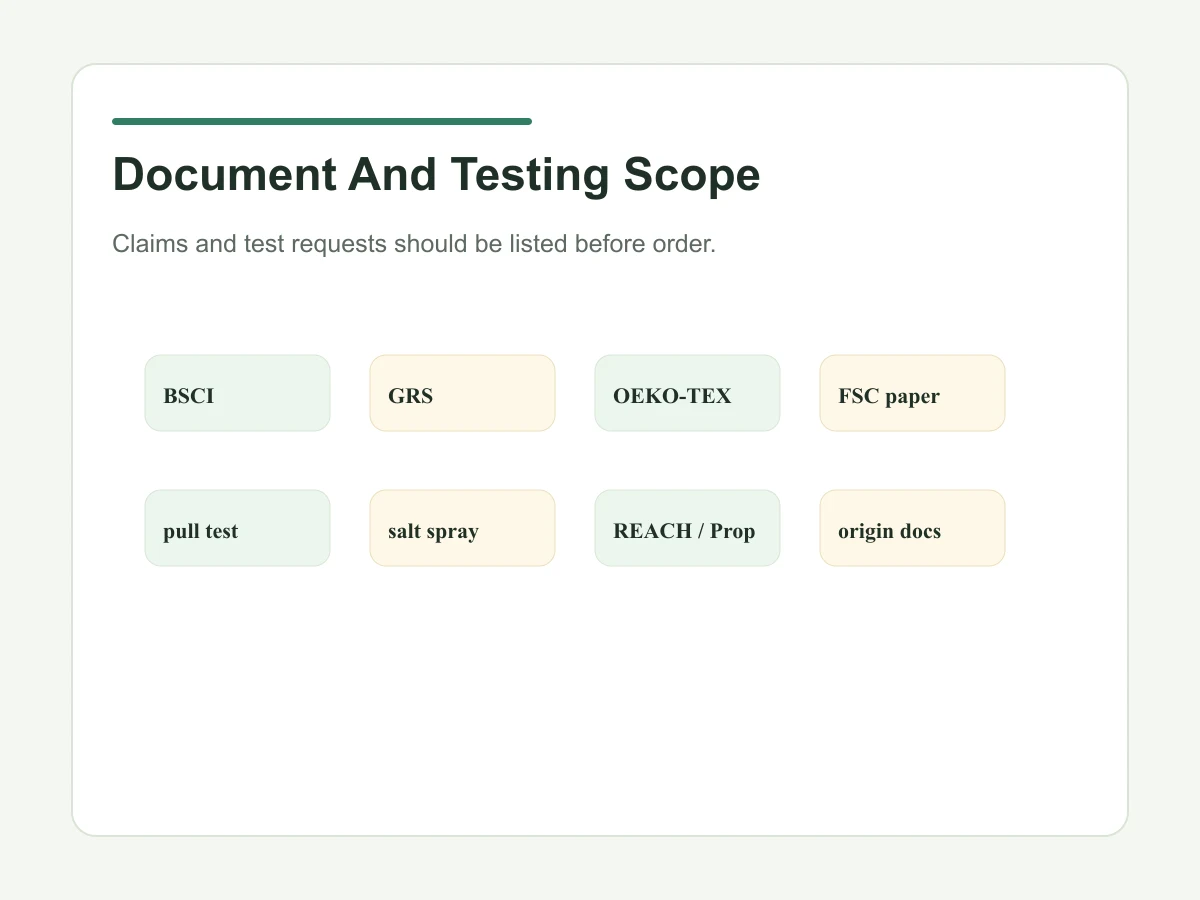
The tech pack should list required documents and tests such as BSCI-related audit information, GRS-related recycled material scope, OEKO-TEX when textile safety is required, FSC paper packaging, material composition, pull testing, colorfastness, origin documents or third-party testing when needed.
Documents should be listed early because file scope can affect cost and timing. If the buyer needs order-specific proof, transaction-related documents or third-party testing, that should not be added after bulk production is already moving.
amfori BSCI audit guidance5 relates to producer audit requests, not material content. OEKO-TEX STANDARD 1006 is related to testing for harmful substances in textile products and components, not a recycled claim by itself.
What sample details matter most for a custom tote bag tech pack?
A tech pack should record sample versions, revision notes, approved material, approved logo method, approved packaging, pre-production sample approval and the final standard used for bulk production and QC.
Sample approval and pre-production sample approval are key control points. If the tech pack and approved physical sample do not match, the safest answer is not to guess which one overrides the other. The buyer and factory should reconfirm the standard.
Inside our process, the approved version, retained sample, photos and production instruction help turn the sample into a bulk production standard. This reduces the risk of a small missing note becoming a large production mistake.
What mistake causes the most rework?
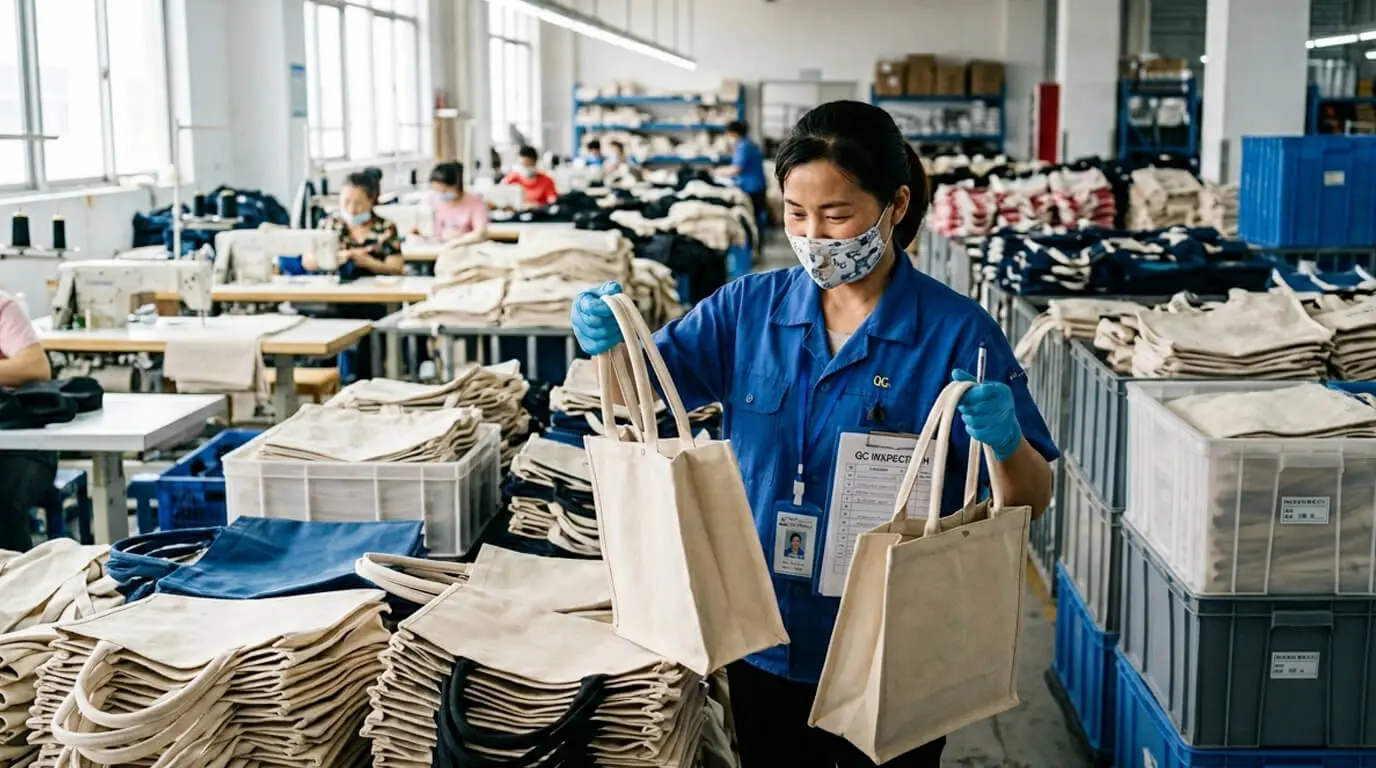
The most common tech pack mistake is leaving key fields vague until after sampling starts: missing dimensions, vague material wording, incomplete logo files, late packaging files, missing document scope and no version history for sample changes.
Many quotation and sampling delays do not happen because the factory cannot make the tote. They happen because the starting information is incomplete. The buyer may add size, material, packaging or label requirements only after the sample has already started.
Logo file issues can also become serious. If a font changes, a color is not defined, or the artwork is not production-ready, the sample can look different from the buyer expectation. That is why a tech pack should record both design intention and production details.
What checklist should buyers use before sampling?
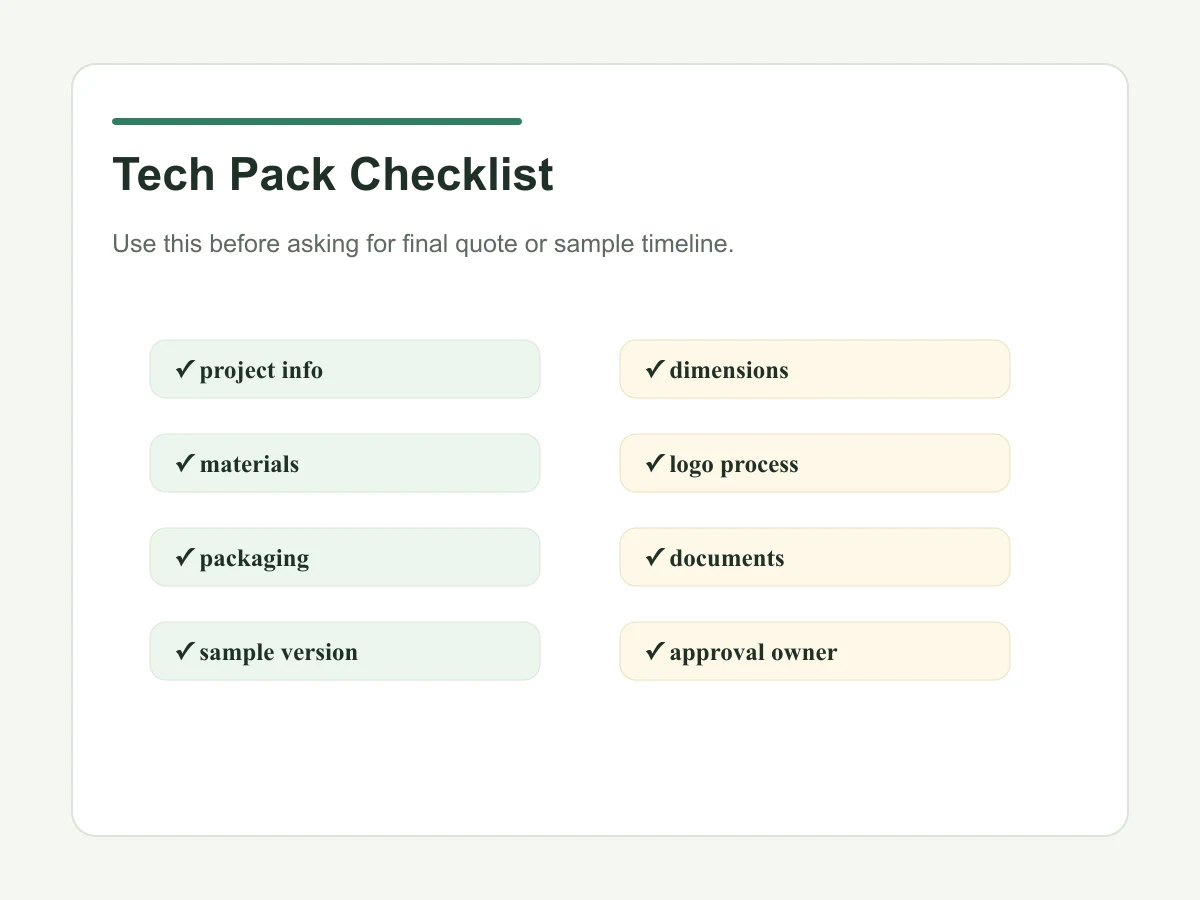
Before sampling, buyers should check project information, dimensions, material, logo file, process, packaging, labels, documents, sample version and approval owner. Missing fields should be resolved before final quote or bulk planning.
| Tech pack section | What to include | Why it matters | Common mistake |
|---|---|---|---|
| Project info | Use case, quantity, colorways, launch date, destination | Helps quote and timeline planning | Vague custom tote bag wording |
| Dimensions | Width, height, gusset, handle drop, pocket size | Controls capacity and material use | No product fit information |
| Material | Composition, GSM, color, surface, handfeel | Affects cost, look and document scope | Vague material claim wording |
| Logo | AI/EPS/PDF, Pantone, size, position, process | Controls sample accuracy | Low-resolution file or live fonts |
| Packaging | Polybag, hangtag, paper card, barcode, labels | Affects cost, timing and retail execution | Packaging added after sample approval |
| Documents | BSCI, GRS, OEKO-TEX, FSC, tests, origin docs | Prevents late compliance changes | Document scope added near shipment |
What should be included in the RFQ?
The RFQ should include use case, quantity, dimensions, material direction, artwork files, label files, packing notes, tolerances, document scope, sample deadline, launch date and delivery destination.
A first quote can start with fewer details, but the tech pack should become more complete before sampling and bulk planning. If the buyer can provide product dimensions, packaging files, barcode files, material claim requirements and delivery timing early, the supplier can reduce quote revisions and sample rework.
- Product use case and order quantity
- Colorways, SKUs, campaign or launch date
- Full measurement diagram and product fit requirement
- Material name, composition, GSM, handfeel and approved color
- Logo artwork, Pantone, process, size and position
- Packaging, labels, barcode and carton mark requirements
- Certification, testing and document requirements
- Sample version record and approval owner
Less suitable fit for this tech pack route
Ecoicolortote is not the right fit for projects below 500 pcs per style without brand context, buyers who refuse to confirm size, material or logo details, or projects that skip sample approval while expecting no production risk.
It may also be less suitable for teams that only want a fast visual mockup and are not ready to define dimensions, artwork, label files, packaging, document scope, sample version control or approval ownership. Ecoicolortote is a stronger fit when the buyer has a real brand project and wants to turn reference photos, product ideas and artwork into a clear tech pack before sampling and bulk production. A tech pack does not need to be overly complex, but it should be complete enough for quotation, sample review, packaging control and QC comparison.
Send your use case, quantity, size idea, material direction, logo file, packaging needs, document requirements and launch date. We can help check whether your project details are ready for quotation, sampling and bulk production. Contact Ecoicolortote.
FAQ: Custom tote bag tech pack guide
What should buyers confirm before sourcing a custom tote bag tech pack?
Buyers should confirm use case, quantity, dimensions, material direction, artwork files, label files, packing notes, tolerances, document scope, sample approval records and launch timeline. These details help the factory quote, sample and inspect the same tote instead of relying on scattered emails, reference photos or unclear verbal comments during later production planning.
What sample details matter most for a custom tote bag tech pack?
Material swatches, logo samples, size measurements, packaging samples, label files, revision notes and the approved pre-production sample should all be recorded clearly. The tech pack should show which sample version is final, which details changed, and which physical sample becomes the bulk production reference for QC, packing review and final inspection.
What MOQ and lead time should buyers expect for a custom tote bag tech pack?
Ecoicolortote is usually a better fit for MOQ 500+ projects. Lead time depends on material availability, artwork complexity, packaging files, document needs and sample approval speed. If the tech pack is incomplete, the project may need extra quotation rounds, sample revisions or file checks before bulk planning can begin with confidence.
Which material or certification evidence should be checked?
Check material composition, recycled or organic claim scope, textile safety needs, FSC paper packaging, audit information, testing requirements and any buyer-specific document checklist. Evidence should match the selected material, packaging, order scope and claim wording, not a general supplier file that may not apply to the actual tote, market or campaign.
What should be included in the RFQ?
The RFQ should include use case, quantity, dimensions, material direction, artwork files, label files, packing notes, tolerances, document scope, target date and delivery destination. If the buyer already has product dimensions, barcode data, packaging files or retailer requirements, those should be included before the first formal quote to reduce later re-quotation.
What mistake causes the most rework?
The biggest mistake is treating reference photos and a logo as a complete tech pack. Missing dimensions, vague materials, late packaging files and unclear sample records often cause rework. A tech pack should turn visual ideas into measurable specifications before the factory starts sampling or bulk preparation for a real order.
When should buyers contact Ecoicolortote?
Contact Ecoicolortote before sampling if your team needs help turning project details into a workable tech pack for an MOQ 500+ custom tote bag project. The most useful brief includes use case, quantity, size idea, material direction, logo file, packaging needs, document requirements and launch timing, especially for retail or GWP deadlines.
Trademark and certification note
Brand names, retailer requirements, certification names and standards mentioned in a tech pack should be used only when they apply to the actual order scope. GRS, OEKO-TEX, FSC, BSCI-related audit information, barcode references and other documentation should be checked against the selected material, packaging, supplier, factory, market and claim wording before the buyer uses them in product pages, hangtags, packaging artwork or retailer submissions.
Sources
- Global Recycled Standard - recycled-content reference↩
- FTC Green Guides summary - environmental marketing claims↩
- GS1 General Specifications - barcode and identification standards↩
- FSC paper and packaging↩
- amfori BSCI audit guidance - producer audit requests↩
- OEKO-TEX STANDARD 100 - textile safety reference↩