Zoe Yu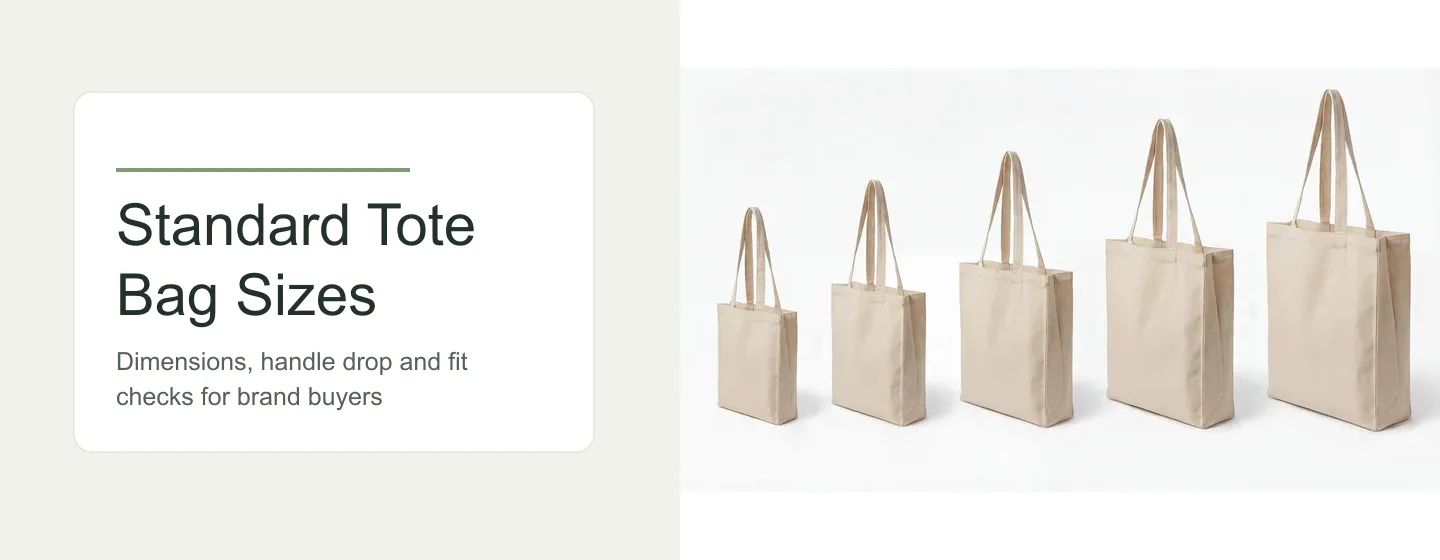
Buyer Summary
- Best for: beauty GWP, retail, hotel welcome, event, Amazon, private label and DTC buyers choosing custom tote bag sizes from 500 pcs per style.
- Main decision: choose tote size by product fit, use case, handle comfort, logo proportion, material structure, packaging volume and budget.
- Factory-side note: the largest tote is not always the best tote; oversizing can increase material cost, packing volume and shipping cost without improving the user experience.
- What to prepare: contents to carry, preferred width, height, gusset, handle drop, logo size, material direction, packaging method, order quantity and target launch date.
A tote bag size chart is useful, but it should not be the only reason a brand chooses a dimension. For custom tote projects, size affects material consumption, structure, logo proportion, packaging, shipping volume and the final customer experience.
TL;DR: Standard tote bag sizes are useful for early planning, but brand buyers should choose dimensions by contents, use case, gusset, handle drop, logo proportion, material structure, packaging method and shipment volume. Beauty GWP, hotel welcome, retail, Amazon/FBA, event and private label projects often need different size logic. The safest route is to measure the real products, confirm carry method, review folded size and approve a physical sample before bulk production.
From our factory side, the best starting question is not "what is the standard size?" It is "what does the tote need to carry, and how should the customer use it?" A beauty GWP tote, hotel welcome bag, retail shopping tote and event giveaway may all need different sizing logic.
Best fit for this tote bag size guide
This guide is best for beauty GWP, wellness, retail, hotel welcome, conference, Amazon/FBA, private label and DTC buyers planning MOQ 500+ custom tote bag projects where bag size affects product fit, user experience, cost and packaging. It is especially useful when the buyer needs to decide width, height, gusset, handle drop, logo area, folded size, carton volume or product-fit testing before sampling. The strongest fit is a team that can share product dimensions, target use case, material direction, logo file, packaging method, order quantity and launch date. Those inputs help the factory recommend a size route that looks good, carries correctly and does not create avoidable material or freight cost.
How is this size guide different from MOQ, material and packaging pages?
This page focuses on tote dimensions: width, height, gusset, handle drop, product fit and folded size. MOQ pages explain quantity and timing. Material pages compare fabric routes. Packaging pages explain labels, polybags, carton marks and retail-ready packing.
If the buyer is still planning quantity and timing, use the custom tote bag MOQ and lead time guide. If the main question is fabric choice, compare the tote bag materials by campaign type page and the rPET, recycled cotton and cotton canvas guide. If the issue is folded size, barcode labels or carton control, review custom tote bag packaging options. This article stays focused on size decisions before drawings, samples and product-fit tests are approved.
What Are Standard Tote Bag Sizes?
Common tote bag sizes range from small mini totes around 10 in x 11.5 in x 2.75 in to large lifestyle totes around 20 in x 14 in x 6 in. For brand projects, the best starting size depends on whether the tote is used for GWP, retail, hotel welcome gifts, events or shopping.
Standard sizes are useful for early planning because they help buyers estimate capacity, logo area and rough cost direction. But a "standard" size still needs to be checked against the actual product set, packaging method and carrying style.
| Size direction | Approximate dimension | Typical use | Watch-out |
|---|---|---|---|
| Mini / small gusseted tote | About 10 in x 11.5 in x 2.75 in | Beauty GWP, small gift set, hotel room item | Check bottle height and gift box fit |
| Small-medium tote | About 10 in x 12 in x 3-4 in | GWP, welcome tote, compact retail gift | Logo proportion can feel large quickly |
| Medium flat tote | About 13 in x 15 in or 15 in x 16 in | Basic retail, event, document or light shopping tote | Flat body has less product depth |
| Medium gusseted tote | About 15 in x 16 in x 4 in | Retail, apparel, private label and product sets | Confirm handle drop and packing volume |
| Large lifestyle tote | About 20 in x 14 in x 6 in | Travel, beach, fitness, resort or lifestyle retail | Higher material and shipping cost |
How Should Brand Buyers Choose a Tote Bag Size?
Brand buyers should choose tote size by testing what the bag must carry, how the user will hold it, what brand feeling it should create and how much budget the project has. A correct tote size is the one that fits the use case, not simply the largest size available.
Start with the contents. If the tote must hold bottles, boxes, apparel, event materials or hotel gifts, measure those items first. Then check whether the bag needs a gusset, lining, zipper, inner pocket or reinforced handle.
Next, check logo proportion. A logo that looks elegant on a medium tote may feel too large on a small GWP tote or too small on a large beach tote. Size and logo placement should be reviewed together before sampling.
Which Tote Bag Size Fits Each Buyer Type?
Beauty GWP and hotel welcome totes usually need small to medium product-fit sizing. Private label retail, lifestyle and fitness totes often need medium to large capacity. Conference, event, retail chain and Amazon projects should balance size with packing volume, labeling and distribution needs.
| Buyer type | Size direction | Why it fits | Confirm early |
|---|---|---|---|
| Beauty / wellness GWP | Small to medium, often gusseted | Fits product sets without looking empty | Bottle height, box size, gift set packing |
| DTC / private label retail | Medium to large | Needs repeat-use value and stronger brand presence | SKU labels, hangtags, packaging and reorder plan |
| Hotel welcome gift | Small to medium | Usually carries room gifts, cards, water or snacks | Guest presentation and in-room packing |
| Conference / event | Medium flat or lightweight gusseted | Useful for documents, sponsor items and handout materials | Carton sorting, logo versions and event date |
| Retail chain / Amazon | Standardized medium sizes | Supports SKU control and repeat production | Barcode, carton marks, packing dimensions |
What Size Works for Beauty GWP Tote Bags?
Beauty GWP tote bags usually work best in small to medium sizes, often around 10 in x 12 in x 3-4 in or 12 in x 13 in x 4 in. If the tote is a simple flat giveaway bag, 13 in x 15 in can also work, depending on the product set.
Beauty GWP tote sizing should begin with the product set. If the tote is too small, the buyer may struggle with packing. If it is too large, the gift can feel empty and less premium. Small gussets often help skincare bottles, jars and boxed items sit better inside the tote.
What Size Works for Private Label Retail Tote Bags?
Private label retail tote bags often start from 15 in x 16 in for a basic flat tote. If the tote needs to carry apparel, boxed products or lifestyle items, a gusseted size such as 15 in x 16 in x 4 in, 16 in x 14 in x 5 in or 20 in x 14 in x 6 in may be more practical.
Retail totes should feel useful after the first purchase. A medium tote can work for basic daily carry, while a large gusseted tote is better for beach, travel, fitness or lifestyle positioning. Heavier canvas, structured rPET or lined construction may be needed when the tote gets larger.
What Size Works for Hotel Welcome Tote Bags?
Hotel welcome tote bags are usually small to medium because they carry water, snacks, maps, room cards and small gifts. Common directions include about 9.25 in x 11.75 in x 4.5 in or 10 in x 12 in x 4 in. Resort or beach welcome totes may be larger.
Hotel welcome tote sizing should match the guest experience. A compact city hotel welcome kit may need a smaller tote, while a resort or beach property may prefer a larger lifestyle tote that guests can reuse during the stay.
Which Tote Bag Dimensions Should Buyers Confirm?
Buyers should confirm width, height, depth or gusset, side width, bottom width, handle drop, shoulder strap length and closure requirements before sampling. These dimensions control not only appearance, but also usable capacity, carrying comfort, packaging and production drawings.
Width and height describe the visible front panel. Gusset depth controls how much the bag can expand. Handle drop controls how the user carries it. Closure and lining can change the effective usable space. Size terminology should stay clear in the sample brief; general measurement references such as ISO 8559-12 can help buyers understand why consistent measurement language matters.
- Width and height of the front panel
- Gusset depth, side width and bottom width
- Handle drop for hand carry, elbow carry or shoulder carry
- Closure type such as open top, zipper, snap or button
- Lining, inner pocket, reinforcement and bottom support if needed
- Logo size, logo position and available print or embroidery area
What Handle Drop Should a Tote Bag Have?
Handle drop is the vertical distance from the bag opening to the inside top of the handle. Hand-carry totes often use 4-6 in, elbow-carry totes use 6-8 in, shoulder-carry totes use 9-12 in, and longer shoulder styles may use 12-14 in.
Handle drop should match how the customer will carry the tote. A short handle can look neat on a small gift tote, but it may be uncomfortable for shoulder use. A long handle can work for shopping and travel, but it may feel too loose on a compact GWP bag.
| Carry method | Common handle drop | Best fit |
|---|---|---|
| Hand carry | 4-6 in | Small gift totes, compact GWP, structured mini totes |
| Elbow carry | 6-8 in | Small to medium retail or welcome totes |
| Shoulder carry | 9-12 in | Shopping totes, lifestyle totes, daily carry totes |
| Long shoulder style | 12-14 in | Beach, travel, fitness or larger lifestyle bags |
How Does Tote Bag Size Affect Cost?
Tote bag size is one of the biggest cost factors because it changes fabric consumption, lining, zipper length, handle length, reinforcement, packing size and shipping volume. A larger tote can be useful, but the size should justify the extra material and logistics cost.
When buyers compare two sizes, the larger tote may use more fabric, longer handles, more lining, larger packaging and larger cartons. For low-budget GWP or event projects, a slightly smaller but better-proportioned tote may be more practical than a large bag with weak material or poor structure.
How Do Material and Logo Process Change With Tote Size?
Material and logo process should be reviewed after the bag size is chosen. Large totes may need better fabric weight or structure to avoid looking too soft, while small totes need careful logo proportion and placement. The size also affects printing area, embroidery scale and trim position.
For large totes, cotton canvas, structured rPET or lined construction may help the bag keep its shape. For small totes, embroidery, woven labels, patches or simple screen printing may look more refined than oversized full-panel artwork. If the logo is complex or full-color, sample testing is important before bulk production. For sewing discussions, references such as ASTM D6193 seam and stitch terminology3 can help teams separate construction language from size language.
How Do Size, Packaging and Retail Labels Connect?
Tote bag size affects folded size, carton volume, hangtag position, barcode label space, SKU labeling and warehouse handling. Buyers planning retail or Amazon projects should confirm packaging and label requirements before approving the sample.
For retail and Amazon-style projects, the tote is not only measured as an open bag. The folded size, individual packing method, barcode label, carton mark and warehouse handling requirements also matter. If a buyer needs barcode or product identification standards, GS1 General Specifications1 can be used as a reference for retail identification and barcode discussions.
Paper hangtags, belly bands and carton labels should also be checked with the folded tote size. If a buyer wants FSC paper packaging, FSC paper and packaging guidance4 applies to the paper item, not to the tote fabric itself.
What Sizing Mistakes Should Brand Buyers Avoid?
The most common sizing mistakes are choosing by photo only, not measuring the products, ignoring gusset depth, choosing the wrong handle drop, forgetting packaging space and changing size after sampling. These problems are best avoided with drawings and physical sample approval.
- Do not choose size from a photo only.
- Do not forget to measure the actual products or gift boxes.
- Do not ignore gusset depth when the tote must hold bottles or boxes.
- Do not choose a shoulder handle when the tote is meant to feel like a compact gift bag.
- Do not change size after sample approval without reviewing cost and timeline again.
- Do not approve bulk production without checking product fit in a physical sample.
What Should Buyers Include in a Tote Bag Size Brief?
A strong tote bag size brief should include target width, height, depth, handle drop, product contents, estimated weight, material direction, logo position, closure, lining, pocket, packaging, quantity, launch date and whether the tote must be hand-carried or shoulder-carried.
If the size is not fixed, send the contents and use case first. The factory can suggest a starting dimension and then confirm it with drawings, sample review and product-fit testing. If the size brief includes recycled materials or textile safety claims, buyers may also need to check references such as the Global Recycled Standard5 or OEKO-TEX STANDARD 1006 separately from the bag dimension discussion.
Tote Size Brief Checklist
Before asking a factory for size advice, buyers should prepare the use case, products to fit, preferred size, gusset requirement, handle drop, logo size, material, packaging method, carton or shipping concern and sample test requirement.
| Brief item | What to send | Why it matters |
|---|---|---|
| Use case | GWP, retail, hotel, event, Amazon, private label or lifestyle tote | Defines capacity and presentation needs |
| Products to fit | Bottle height, box size, apparel size, document size or gift contents | Prevents wrong depth or height |
| Dimensions | Width, height, gusset and handle drop | Turns the idea into a production drawing |
| Logo | Logo size, placement and process direction | Controls front-panel balance |
| Material | rPET, cotton canvas, recycled cotton, organic cotton or other direction | Size affects structure and hand feel |
| Packaging | Folded size, polybag, paper card, carton mark or retail label | Size changes packing and shipping cost |
| Timeline | Sample date, launch date and delivery destination | Lets the factory check whether the plan is realistic |
Tote size brief validation checklist
This is a planning checklist, not a customer case or price result.
- List the real contents and their dimensions before choosing a flat tote size.
- Confirm width, height, gusset and expected filled shape.
- Record hand, forearm or shoulder carry and the required handle drop.
- Review logo proportion and safe area on the filled sample.
- Approve fold method, individual packing and pieces per carton.
- Name the sample-approval owner and the version used for bulk comparison.
When oversized capacity is the first procurement question, continue to the Custom Large & XL Tote Bags owner page.
Less suitable fit for this tote size route
This size planning route is less suitable for buyers who cannot share use case, contents, approximate quantity, material direction, logo placement or packaging needs before asking for exact dimensions and pricing.
It may also be less suitable for orders below MOQ 500 pcs per style, projects that approve only a flat mockup without physical product-fit sampling, or buyers who change size after sample approval while expecting the original cost and timeline to stay unchanged. Ecoicolortote is a stronger fit for brand projects where the buyer wants a practical size recommendation based on product contents, handle comfort, logo proportion, material structure, folded size, packaging and delivery plan. A clear size brief helps avoid oversized bags, weak structure, poor logo balance and unnecessary carton volume.
FAQ
What is the most common tote bag size?
A common retail basic size is around 15 in x 16 in, especially for flat daily-use totes, documents and simple shopping programs. For beauty GWP or hotel welcome totes, small to medium gusseted sizes are often more practical because they fit product sets without feeling oversized. The best size still depends on contents, handle drop, material structure and packaging method.
Should a tote bag have a gusset?
If the tote needs to hold bottles, gift boxes, apparel, hotel items or retail products, a gusset is usually helpful because it adds usable depth and helps the bag stand or pack better. A flat tote can work for simple giveaways, documents or light items. Buyers should test the actual product set before deciding whether a gusset is necessary.
Does tote bag size affect price?
Yes. Size is one of the largest cost factors because it changes fabric consumption, handle length, lining, zipper length, reinforcement, packaging size and shipping volume. A larger tote can also require heavier fabric or stronger construction to avoid looking weak. Buyers should compare size, material and folded carton volume together instead of judging only the open bag dimension.
Can 500 pcs include more than one size?
MOQ is usually discussed per style, so multiple sizes may create separate setup, cutting and sample requirements. If a buyer wants more than one size within 500 pcs, the factory should review material, color, pattern, logo method and packaging before confirming whether it is practical. In many cases, one shared size is more cost-aware for first orders.
Do buyers need a physical sample before bulk production?
Yes. A physical sample is important because size, handle drop, structure and product fit cannot be judged reliably from a flat image alone. A sample lets buyers test real product contents, logo proportion, carry comfort, folded size and packaging. For beauty, hotel, retail and event projects, sample approval should happen before bulk production and carton planning are locked.
Can airline amenity-style tote sizing be discussed without a real case?
Yes, but it should be written as capability and sizing logic, not as a direct case study unless the supplier has that actual project experience. The correct approach is to review contents, weight, storage limits, packaging, folded size and carry method. Buyers should avoid implying a completed airline case when only development capability or sizing principles are being discussed.
What should buyers send before asking for tote size advice?
Buyers should send the use case, product dimensions, target quantity, preferred material, logo size, handle style, packaging method, destination and launch date so the factory can check size, gusset and product fit before sampling. Photos or measurements of the actual contents are especially useful because they help avoid bags that are too shallow, too tall, too wide or expensive to pack.
Send your product dimensions, use case, target quantity, material direction, logo file, packaging needs and launch date. Ecoicolortote can help check tote size, gusset, handle drop and product fit before sampling. Contact Ecoicolortote.
Trademark and certification note
GS1, Amazon, FSC, GRS, OEKO-TEX, BSCI, ISO and other certification, standard, marketplace or audit names belong to their respective organizations. This article is a buyer-side sizing and specification guide and does not claim that every product, material, packaging item, order or shipment automatically follows every listed standard. Buyers should confirm current retailer rules, barcode requirements, document scope, material coverage and destination-market requirements before finalizing quotation, packaging, labels or bulk production.
Sources
- GS1 General Specifications - barcode and identification standards↩
- ISO 8559-1 - size designation and body measurement reference↩
- ASTM D6193 - stitches and seams terminology reference↩
- FSC paper and packaging - packaging claim reference↩
- Global Recycled Standard - recycled material reference↩
- OEKO-TEX STANDARD 100 - textile safety reference↩