Zoe Yu
 Private label tote care labels and hangtags should be planned before sampling, because care text, fiber or material wording, barcode space, hangtag artwork, claim wording, carton labels and approval ownership can change quote scope, sample timing, label printing and retail launch readiness.
Buyer Summary
- Best for: private label, retail, DTC and brand buyers preparing MOQ 500+ tote bag launches with care labels or hangtags.
- Main decision: lock care text, material wording, claim scope, barcode area, hangtag artwork and sample approval before label production.
- Factory-side note: late label changes can delay sampling, printed hangtags, carton labels, barcode checks and retail pack-out.
- What to prepare: label copy, logo files, barcode data, material direction, hangtag size, packaging route, carton marks, documents and approval owner.
Private label tote care labels and hangtags work best when buyers confirm care wording, material or fiber wording, barcode ownership, logo files, claim language, hangtag size, packaging, carton marks and approval owner before sampling. The factory quote should cover what will actually be printed, sewn, packed and shipped.
Ecoicolortote can support label placement, hangtag production coordination, sample review and pack-out planning, but final retail, legal, barcode and claim approval should come from the buyer or their authorized team.
How is this different from private label, packaging and logo file pages?
This article is narrower than the private label totes product page, which explains the broader product route for retail buyers. It also differs from private label tote bags for retail brands, which covers MOQ, materials and launch planning, and from custom tote bag packaging and labeling, which covers packaging execution more broadly. The focus here is one pre-launch task: locking care label, hangtag, barcode and label files before the sample becomes the retail approval reference.
If the buyer is still choosing fabric, tote structure or logo method, start with the private label route. If the product spec is mostly clear but label artwork, care instructions, barcode ownership or carton marks are still loose, use this checklist before approving the sample.
Care labels and hangtags look small, but they sit between marketing, compliance, retail operations and factory packing. A buyer may approve the tote shape and logo, then discover that the care label text, fiber claim, country wording, barcode field or hangtag hole position was never frozen. That creates extra sample rounds, late artwork changes and confusion when cartons are prepared for retail launch.
The commercial goal is simple: help the buyer send a complete RFQ and reduce late-stage friction. A clear label file helps Ecoicolortote quote more accurately, prepare the first sample with fewer assumptions and guide qualified buyers toward contact instead of endless email clarification.
What should be inside the care label file?
The care label file should include label size, placement, stitching method, language, care instruction, fiber or material wording, origin wording if required by the buyer, brand ownership statement and any claim restrictions. Buyers should avoid sending a loose screenshot. The factory needs editable text, approved wording and clear placement reference.
Care label requirements vary by product category and market. The FTC Care Labeling Rule describes care-label obligations for textile wearing apparel and certain piece goods1. Tote buyers should confirm their own retail market requirements, because a promotional tote, reusable shopping tote, fashion tote and packaged retail tote may be treated differently by the buyer's internal legal or retail team.
| Label field | What to confirm | Why it matters |
|---|---|---|
| Care wording | Spot clean, hand wash, do not bleach or buyer-approved wording | Prevents late compliance review changes |
| Material claim | Cotton canvas, rPET, recycled cotton or blended wording scope | Keeps claims aligned with documents and product route |
| Placement | Inside seam, side seam, pouch, handle area or no sewn label | Affects stitching, comfort and sample appearance |
| Language | English only, bilingual or market-specific wording | Retail buyers often need internal approval before printing |
How should buyers prepare the hangtag file?
The hangtag file should show final artwork, size, paper weight expectation, hole position, string or fastener type, barcode area, retail price field if any, product name, claim wording, QR code need and attachment location. If the hangtag carries sustainability wording, material composition or certification references, the buyer should match those claims to documents before print approval.
For material and certification scope, use the materials hub and tote bag certification documents guide. International care symbols are commonly discussed under textile care labelling systems; ISO 3758 covers care labelling code using symbols for textile articles2. Buyers should still confirm whether their retail market accepts symbol-only, text-only or combined care instructions.
When does a private label tote need barcode planning?
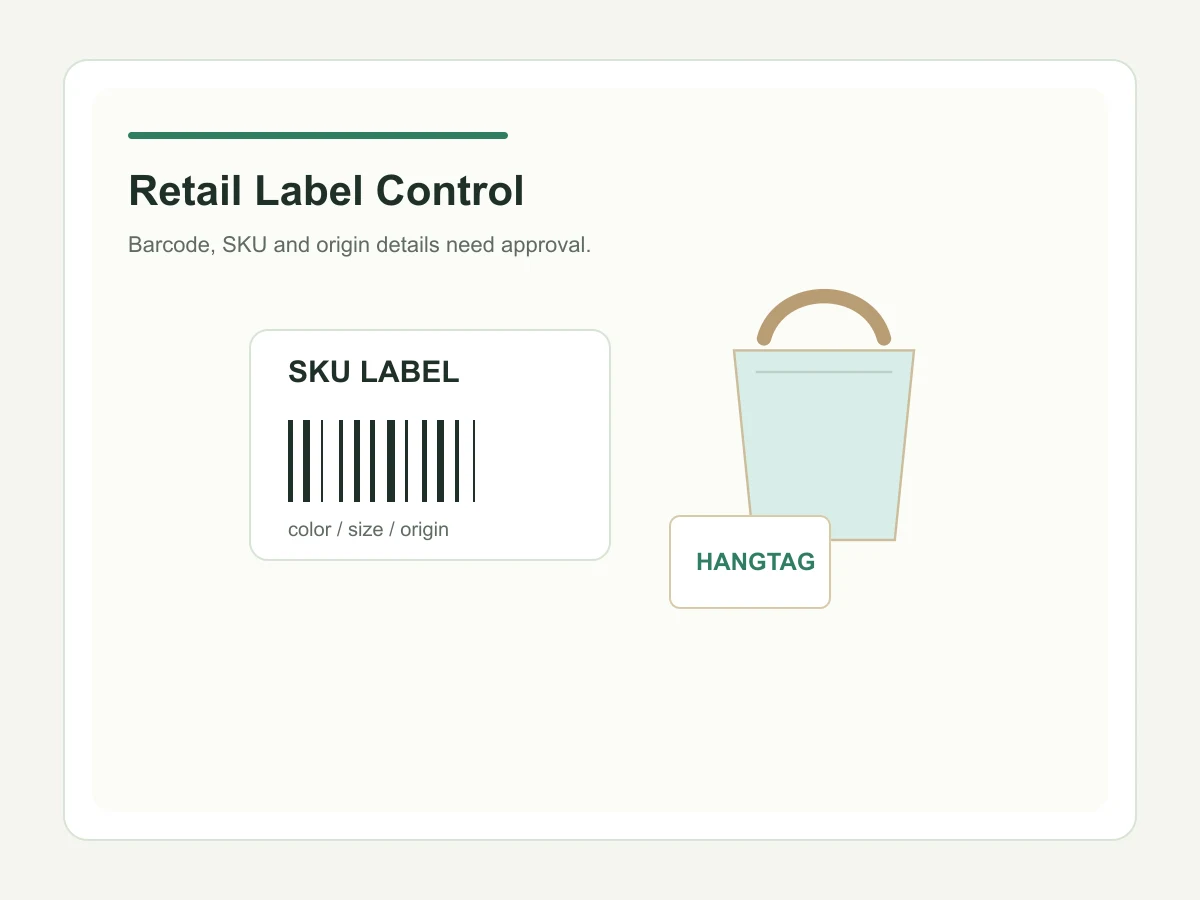
A barcode is usually needed when the tote is sold as a retail SKU, tracked in store inventory, packed into retailer distribution, listed on marketplace systems or tied to an internal product database. A barcode may not be needed for a simple GWP or internal campaign tote. The buyer should decide early because barcode size, quiet zone, print method and hangtag layout can affect artwork.
Ecoicolortote can prepare a printable space and follow the buyer's file, but barcode ownership and number assignment should come from the buyer or their authorized system. GS1 barcode standards provide a common global framework for product identification3. If the buyer needs a GTIN, SKU label or retailer barcode, send the final data before hangtag printing.
What should buyers check on the label sample?
The buyer should check label size, font readability, stitching position, color contrast, hangtag attachment strength, barcode scan test, folded tote presentation, packaging fit and whether the sample matches the approved artwork file. The sample should be reviewed by the person responsible for retail launch, not only the designer who prepared the artwork.
For artwork preparation, review logo file requirements for custom tote bags. For physical sample checks, use custom tote bag sample evaluation. If color matching is important, Pantone references can help align color discussions between design and sample review4.
How should label files connect to carton marks?
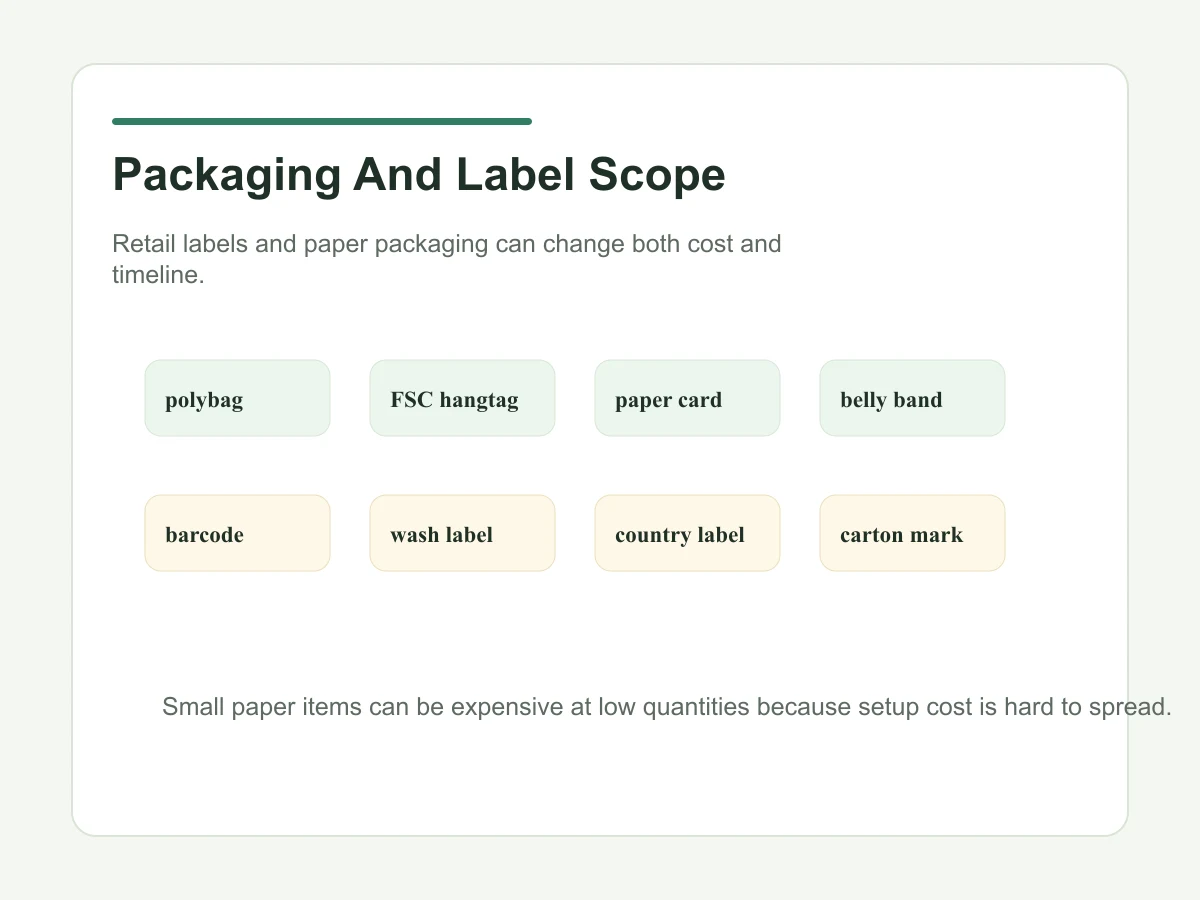
Care labels and hangtags are product-level files, but carton marks are operational files. Buyers should connect them in one launch folder: product name, SKU, barcode, color, quantity per carton, carton sequence, destination, purchase order, retail channel and reserve stock rule. If carton wording arrives late, warehouses may need to relabel finished cartons and delay shipment readiness.
For packaging and carton planning, review custom tote bag packaging options. ISO 780 covers pictorial marking for handling packaged goods5, and buyer-specific carton marks should still follow the retailer, freight forwarder or warehouse requirement.
When should care label and hangtag decisions be frozen?
Freeze care label wording and hangtag layout before the first sample if the launch timeline is tight. Freeze barcode, retail price field, claim wording and carton mark before bulk packing. Sample timing is confirmed after the material, construction, logo method, artwork, packaging and approval scope are clear; the working schedule also depends on revision speed and current capacity. Bulk production timing is confirmed after sample approval, based on material availability, process complexity, quantity, packaging, delivery plan and current capacity.
For inspection planning, ISO 2859-1 is commonly referenced for sampling inspection discussions by acceptance quality limit6. Standard sample fees can normally be credited or refunded against qualified bulk orders of 1,000 pieces or more, but special molds, metal plates, hardware tooling or unusual trim setup may not be refundable and should be confirmed before sampling.
Best fit for this care label and hangtag route
This route is best for private label retail buyers, DTC sourcing leads, merchandising operations teams, store launch managers, ecommerce SKU owners and brand operators planning MOQ 500+ tote bags with care labels, hangtags, barcode space, retail packaging or carton marks. It fits projects with a real brand, a launch window, a sample-first workflow and internal approval from design, buying, operations or compliance. It is especially useful when the tote will be sold as a SKU, placed in a store opening, packed into retail cartons, used in a member campaign or reviewed by a buyer who needs label files to match packaging and inventory systems.
Less suitable fit for this care label and hangtag route
This route is less suitable for blank tote orders, one-piece personal gifts, lowest-price-only quote requests, urgent projects with no sample window, or campaigns where the buyer has no brand file, no approved care wording and no retail launch process. It is also not the right route for a simple event giveaway that does not need barcode, care label, retail hangtag or carton-level inventory control. Those buyers can use a simpler custom tote RFQ instead of a private label label-planning workflow.
Approval workflow: freeze label files before the final sample
Prepare one controlled approval folder containing care-label wording, hangtag artwork and dieline, buyer-provided barcode data, product name, packaging method, carton marks and the approval owner. The final sample should show the actual label positions and hangtag attachment, not only the tote body.
If legal or material wording is still under review, mark it as open and do not call the sample the final production reference. Freezing the files before sign-off reduces avoidable label reprints and keeps product, packaging and retail data aligned.
What should buyers send before requesting a quote?
Send material preference, tote size, logo file, print position, MOQ, target delivery market, care label wording, hangtag artwork, barcode data or ownership note, packaging method, carton mark format, sample approval owner and launch window. If Ecoicolortote is only producing the tote and not assigning the barcode, state that clearly so the printable area can be reserved without confusing barcode responsibility.
For broader product planning, start with private label totes. For label execution, review custom tote bag packaging and labeling. When the label file is ready, send it through the Ecoicolortote contact page.
Do private label tote bags always need care labels?
Not every tote project uses the same care label route. Requirements can depend on product category, material, retail market, buyer policy and whether the tote is sold as a retail product, used as a promotional item or packed as part of a gift set. Buyers should confirm their own retail and legal requirements before final artwork approval. Ecoicolortote can prepare placement and production files, but the buyer should approve final wording.
What should buyers include in a care label file?
A care label file should include approved material or fiber wording, care instructions, origin wording if required, brand name, size or item reference if used, symbol or text direction, label dimensions, fold type, placement and language requirements. The file should also show whether the label is sewn into the seam, attached inside the tote or coordinated with a hangtag. Clear label files help prevent sample revisions and production delays.
Who should provide barcode numbers for private label totes?
Barcode ownership and number assignment should come from the buyer, retailer, GS1 account or authorized internal system. Ecoicolortote can reserve print space, place a barcode graphic and follow the approved file, but it should not invent GTIN, SKU or retailer barcode data. Buyers should send final barcode artwork and confirm scannability requirements before hangtag or sticker production starts.
How is this different from a general private label tote page?
A general private label tote page explains the overall product route, materials, MOQ and brand positioning. This label and hangtag guide focuses on the operational details that can delay a retail launch: care text, hangtag artwork, barcode space, claim wording, packaging labels, carton marks and sample approval. It is useful after the buyer knows the tote direction but still needs to lock retail-ready files.
When should hangtag artwork be approved?
Hangtag artwork should be approved before the production sample or pre-production sample is treated as final. The artwork should include logo, tagline, barcode or QR space, claim wording, material reference, size, hole position, string or attachment method and print color. Late hangtag changes can affect sample timing, printing cost, packing sequence and carton readiness, especially for retail or DTC launch programs.
Are sample fees refundable for private label label projects?
For qualified bulk orders of 1,000 pieces or more, standard sample fees can normally be credited or refunded against the order value. Buyers should confirm before sampling because special trims, custom hardware, repeated artwork changes, special label materials, unusual hangtag finishes or tooling may not be refundable. The safest route is to agree the sample fee, approval criteria and refund condition before files enter production.
How can buyers avoid label-related launch delays?
Buyers can reduce delays by sending one approved folder with care label copy, hangtag artwork, barcode data, logo files, claim wording, material direction, packaging notes, carton marks, destination market and approval owner. The sample should show the actual label and hangtag route, not only the tote body. When legal, retail and operations teams review the same sample, production changes are easier to control.
Factory background and document route
Ecoicolortote supports custom tote bag buyers with material selection, care label placement, hangtag file coordination, logo process planning, packaging details, sample approval and production follow-up. Document needs are scope dependent and should be discussed against the selected material, packaging and destination market before the buyer confirms claim wording.
For private label tote programs, the most useful factory discussion is practical: which material route supports the label wording, which hangtag size fits retail data, which barcode or QR area should remain clear, which packaging route prevents SKU confusion, and which documents or references apply to the actual order scope. Buyers should avoid assuming that every material, package or shipment automatically carries every audit, certificate or standard reference.
Send your tote label and hangtag brief before sampling. Share quantity, care wording, material direction, artwork, barcode data, packaging, carton marks, destination market and deadline so Ecoicolortote can review sample route, quote scope and production timing before bulk production. Contact Ecoicolortote.