Zoe Yu
Buyer Summary
- Best for: beauty, wellness, DTC, retail, Amazon, hotel and event buyers preparing a custom tote bag RFQ from 500 pcs per style.
- Main decision: A useful RFQ should explain quantity, size, material direction, logo artwork, packaging, documents, timeline, destination and use case before asking for a quote.
- Factory-side note: Most quote delays happen before sampling because the buyer's brief is missing details that affect cost, logo process, packaging, certification or lead time.
- What to prepare: Send your target quantity, product-fit requirement, material direction, logo file, Pantone colors, packaging needs, required documents and launch date.
A custom tote bag RFQ is not only a price request. It is a production brief that helps the factory judge quantity, size, material, logo process, packaging, documents, timeline and delivery risk before quoting.
TL;DR: A useful custom tote bag RFQ should include quantity, colorways, use case, size, material direction, logo artwork, Pantone references, packaging, label files, required documents, destination and launch date. If details are undecided, buyers should explain budget direction, brand positioning and what the tote needs to carry. The fastest quote is not always the safest quote; the useful quote is the one based on enough information to plan sampling, bulk production, packing and delivery.
If a buyer only asks, "How much per bag?" a custom tote bag factory can only give a very rough answer. A real quote needs a brief: quantity, size, material direction, logo file, color, packaging, timeline, destination and use case.
From our factory side, most quote delays happen before sampling starts. The buyer may have a good product idea, but the RFQ is missing the details that affect material cost, logo process, packaging cost, certification documents or lead time. Then both sides spend days asking and answering basic questions.
Ecoicolortote works with qualified brand buyers from 500 pcs per style. If your team already has full specifications, we can quote faster. If your team is still choosing material or logo process, we can also help reverse-engineer a workable plan from budget, use case and brand positioning.
Best fit for this RFQ checklist
This checklist is best for beauty, wellness, DTC, retail, Amazon/FBA, hotel, resort, airline gift and event buyers preparing a custom tote bag RFQ from MOQ 500 pcs per style. It is especially useful when the buyer needs a realistic quote for material, logo process, sample route, packaging, label files, document scope and delivery timing before sampling starts. The strongest fit is a buyer who can share target quantity, colorways, product-fit needs, artwork, Pantone references, packaging expectation, destination market and launch date, even if the final material or size still needs factory advice.
Why Does a Clear RFQ Brief Matter?
A clear RFQ brief helps the factory judge material, logo process, packaging, document scope, cost factors and timeline before quoting. Without it, the quote is only a rough estimate and the project may need repeated re-quotation later.
Custom tote bag pricing is not decided by size alone. A 500 pcs project can be simple or complex depending on the fabric, colorways, logo process, lining, zipper, labels, hangtags, recycled-content claim, packaging and delivery destination.
When the brief is incomplete, the quote may look fast, but it is not useful. From our side, we would rather ask a few careful questions first than give a number that changes after the buyer sends artwork, packaging files or certification requirements.
What Information Should Buyers Send First?
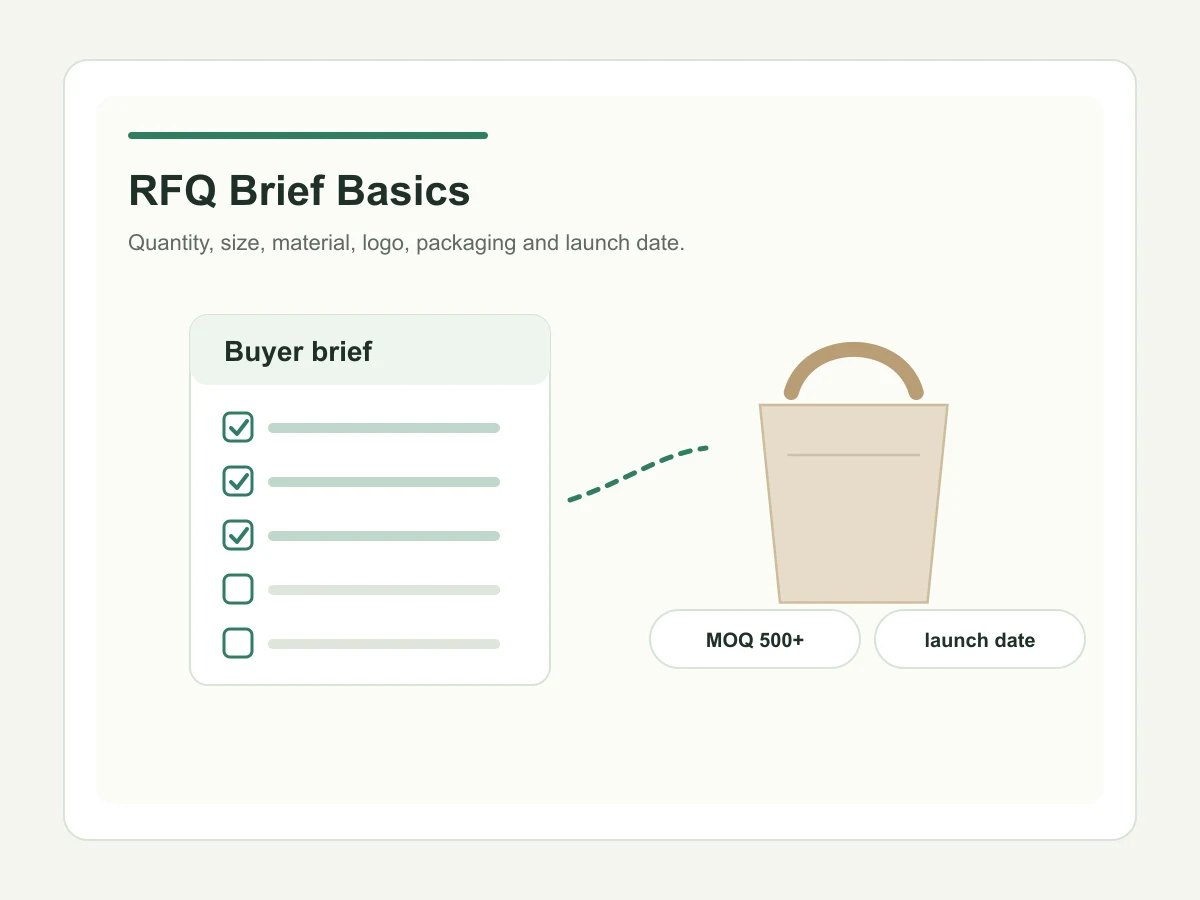
A practical custom tote bag RFQ should include quantity, size, material direction, logo file, color requirement, packaging requirement, target launch date, shipping destination and use case. If some details are not fixed, state the goal and budget direction.
The minimum useful brief should answer these questions: How many bags? What will the tote carry? Is it a GWP item, a retail SKU, a hotel welcome tote or an event gift? What material direction does the brand prefer? What logo file is available? What packaging and label details are needed? Buyers can review GWP tote bag programs when the project is campaign-driven.
If the buyer does not know the exact material, that is workable. We can recommend options based on budget, brand positioning, use case and logo process. If the buyer does not have a full design drawing, we can help with a basic layout or mockup direction based on the logo, dimensions and purpose.
| RFQ item | Why it matters |
|---|---|
| Quantity | Affects unit cost, setup cost, material purchasing and packing plan |
| Size / structure | Controls material usage, carrying function and carton volume |
| Material direction | Shapes budget, hand feel, brand story and document options |
| Logo file | Determines process, clarity, color matching and sample risk |
| Packaging | Affects cost, label control, lead time and retail readiness |
| Launch date / destination | Helps the factory judge whether the plan is realistic |
| Buyer Type | RFQ Focus | Why It Matters |
|---|---|---|
| Beauty / wellness GWP | Campaign date, product fit, material story and packaging | GWP projects are deadline-driven and brand-sensitive. |
| DTC / private label | Label files, packaging, SKU details and repeatability | The tote may become a retail product or recurring brand item. |
| Retail chains | Quantity, barcode, carton marks and compliance documents | Large orders need stable production control and store-ready packing. |
| Amazon sellers | Packaging, SKU labels, dimensions and color consistency | Retail appearance and marketplace-ready control matter. |
| Hotel / airline gifts | Presentation, durability, guest experience and delivery date | Gift quality reflects the brand or loyalty program experience. |
| Event companies | Logo visibility, budget, deadline and quantity | Event gifts need fast, predictable production and clear branding. |
How Should Quantity, MOQ and Colorways Be Explained?
Ecoicolortote custom tote projects start from 500 pcs per style. Two colorways can often be discussed within a 500 pcs project, but this depends on material, color and printing setup. For more colorways, 200 pcs per color is usually more practical.
Quantity affects much more than the unit price. It affects material sourcing, printing setup, sewing arrangement, packaging cost, label setup, document cost sharing and production scheduling.
If a buyer asks "500 pcs how much?" without size, material or logo artwork, we usually need to clarify the brief first. Otherwise, the quote can only be a rough reference, not a reliable production quote.
For 3-5 colorways, each color should usually have enough quantity to make material and production setup practical. Lower quantities are not always impossible, but the unit cost and operation risk are usually less attractive for serious brand projects.
What Size and Structure Details Should Be Included?
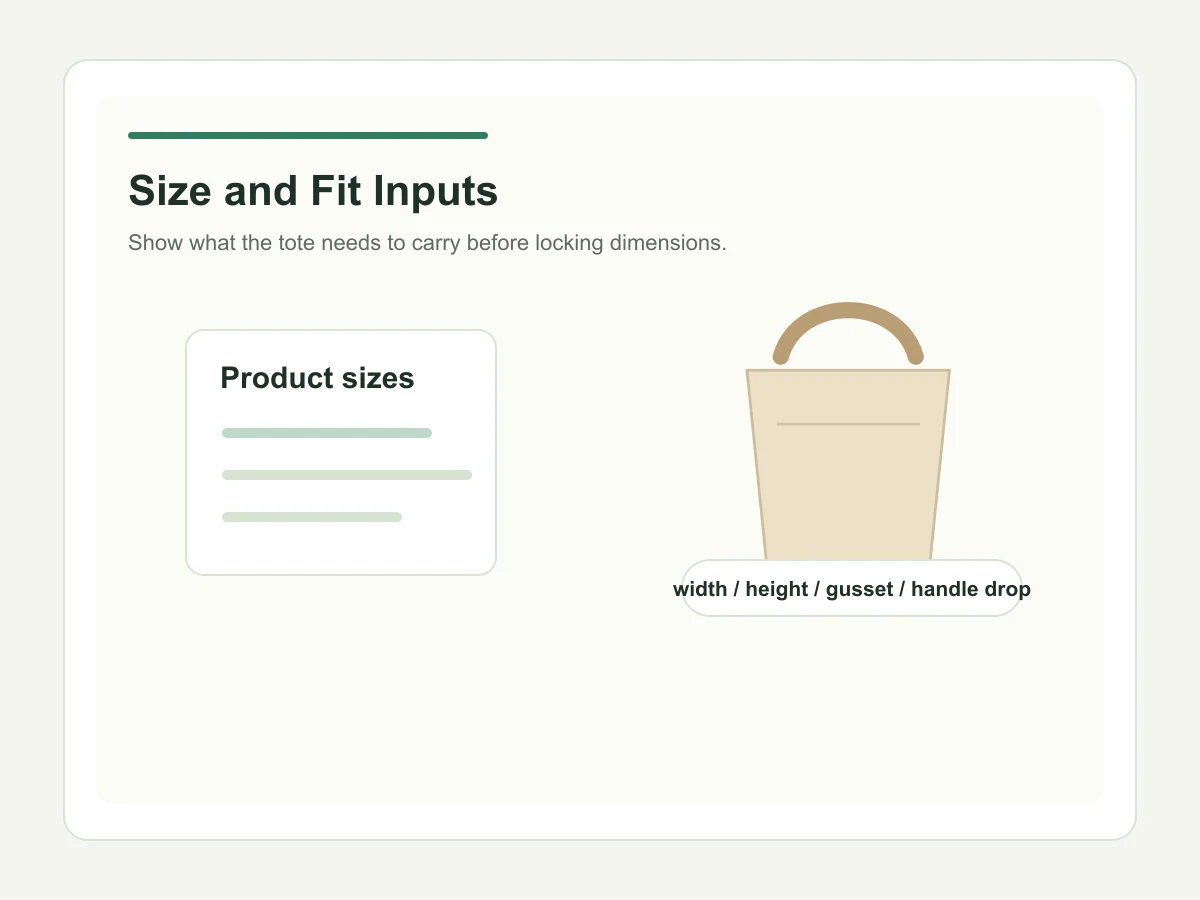
Buyers should share width, height, gusset, side width and handle drop when possible. If the size is not fixed, send the real product size, gift box size or bottle height so the factory can suggest a practical tote dimension.
For many brand projects, the best starting point is not a random tote size. It is the product the tote needs to carry. A beauty GWP tote may need to fit skincare bottles or a gift box. A hotel welcome tote may need to hold water, snacks, cards and room gifts. A retail tote may need stronger carrying comfort and a more reusable structure.
If the tote needs a zipper, inner pocket, lining, magnetic snap, metal hardware or reinforced handle, these details should be included at RFQ stage. Each one can affect cost, sample time and production planning.
If your team is still choosing the bag size, review our standard tote bag size guide before finalizing the quote brief.
How Should Buyers Describe Material Direction?
If the buyer has not selected material, the RFQ should explain budget direction, use case, brand positioning, logo process and whether the project needs a recycled or natural material story. The factory can then recommend a workable material route.
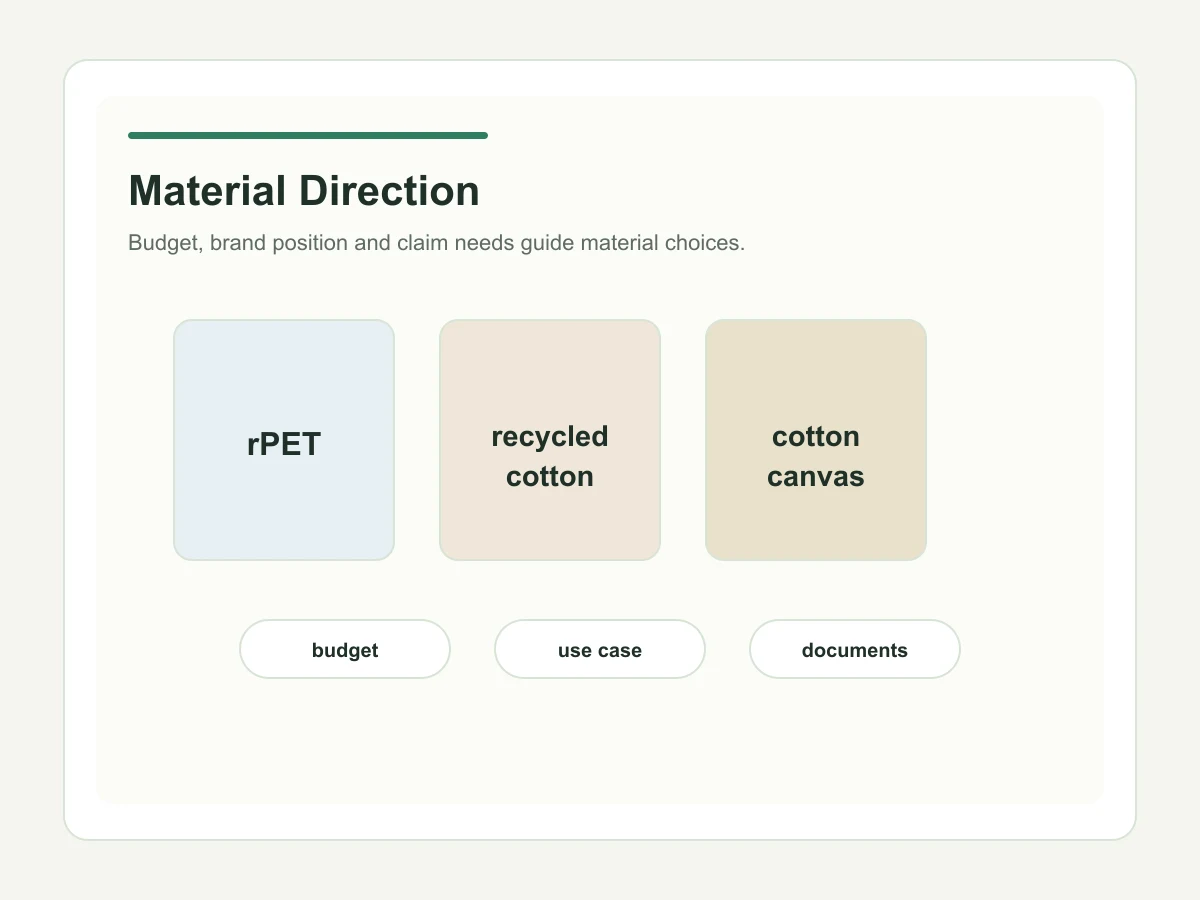
Common custom tote bag materials include rPET, recycled cotton, cotton canvas, organic cotton, bamboo fiber and vegan leather. But they should not all be treated as equal choices. For many brand projects, cotton canvas, recycled cotton and rPET are more common starting points, while organic cotton, bamboo fiber and vegan leather may be selected for more specific positioning. For logo-driven projects, custom logo tote options can help buyers connect material choice with artwork requirements.
One detail is worth clarifying early: recycled cotton can mean different compositions. A recycled cotton blend with polyester can be much more budget-friendly. A 100% recycled cotton option usually costs closer to regular cotton. The composition affects cost, hand feel, appearance and document wording.
If the buyer wants an environmentally conscious direction but has a limited budget, we may suggest recycled cotton blend, recycled-content canvas, rPET or a simpler packaging plan. If the buyer wants a more premium look but has budget limits, we usually keep one strong premium detail instead of adding every upgrade at once.
For a deeper comparison, see our rPET, recycled cotton and cotton canvas material guide.
What Logo Files and Process Details Are Needed?
Vector logo files such as AI, EPS, PDF or SVG are preferred for production. JPG or PNG files can be used for early reference, but they are not ideal as final production artwork, especially for small text, Pantone matching or complex logo processes.
Logo artwork is one of the biggest reasons RFQs slow down. A low-resolution image may look acceptable on screen, but it can create problems in embroidery, screen printing, heat transfer, woven labels, leather patches or metal plates.
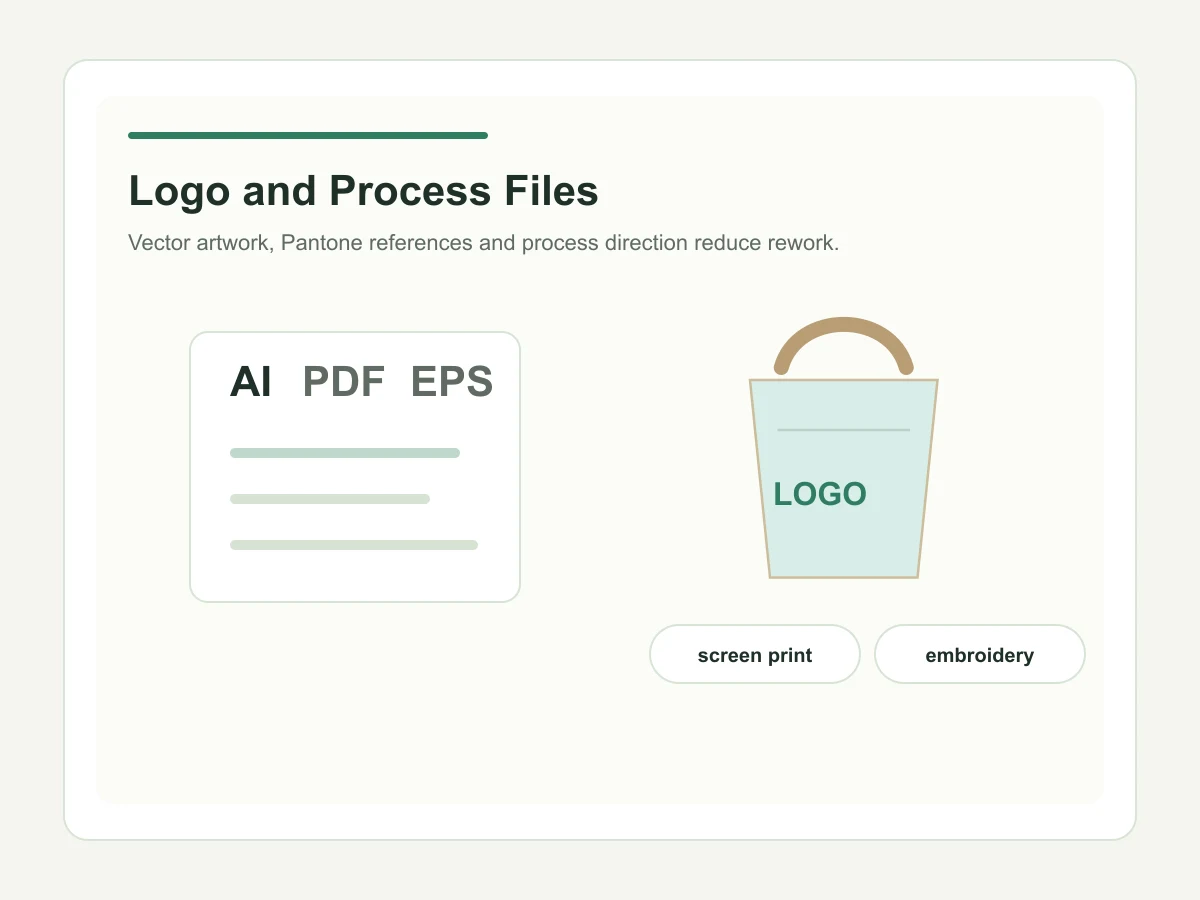
Pantone references are strongly preferred. If the buyer does not have Pantone numbers, we can start with brand files, reference images or physical color samples, then use sampling to confirm the closest workable result. Fabric, paper and screen colors never behave exactly the same, so sample confirmation matters.
If the buyer does not know which logo process to choose, we can recommend based on the logo artwork, material, budget, use case and brand positioning. Multi-color logos, gradients, photo-style graphics, small text and metal plate molding should be mentioned early because they affect cost and sampling time.
For process comparison, see our screen printing vs embroidery guide.
What Packaging and Label Details Belong in the RFQ?
Packaging requirements should be included in the RFQ because polybags, recycled-content polybags, FSC kraft hangtags, paper cards, belly bands, dust bags, barcode stickers, wash labels and origin labels all affect cost, timing and production control.
For private label and retail tote projects, packaging and labels are part of the product, not a final decoration. Buyers should mention barcode stickers, SKU labels, hangtags, wash labels, material composition labels, origin labels, price stickers, paper cards and carton marks as early as possible.
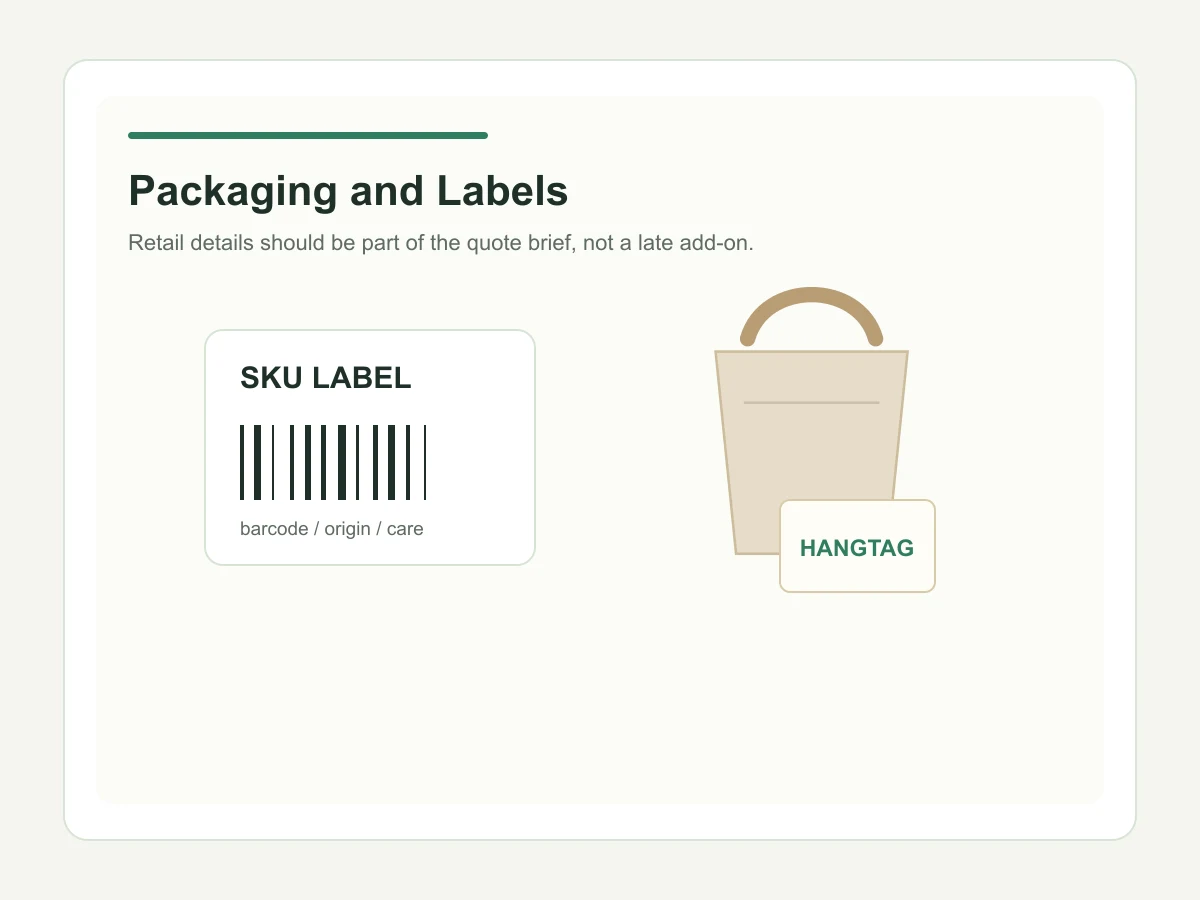
Small-quantity paper cards and hangtags can be more expensive per piece because machine setup cost is spread over fewer pieces. If packaging is added late, it can also delay final packing, especially when artwork review or barcode sorting is involved.
For packaging details, review our custom tote bag packaging options guide.
Which Documents and Certifications Should Be Mentioned Early?
If the project requires BSCI, GRS, OEKO-TEX, FSC, testing reports, certificate of origin or order-specific documents, the buyer should mention this in the first RFQ. Document requirements can affect material choice, cost and timeline.
Factory audit and material documents should not be treated as afterthoughts. If the buyer needs BSCI, GRS, OEKO-TEX, FSC paper packaging, test reports or certificate of origin, the requirement should be clear before material and packaging routes are locked. amfori BSCI audit guidance5 is a useful reference when buyers need to understand producer audit request workflows.
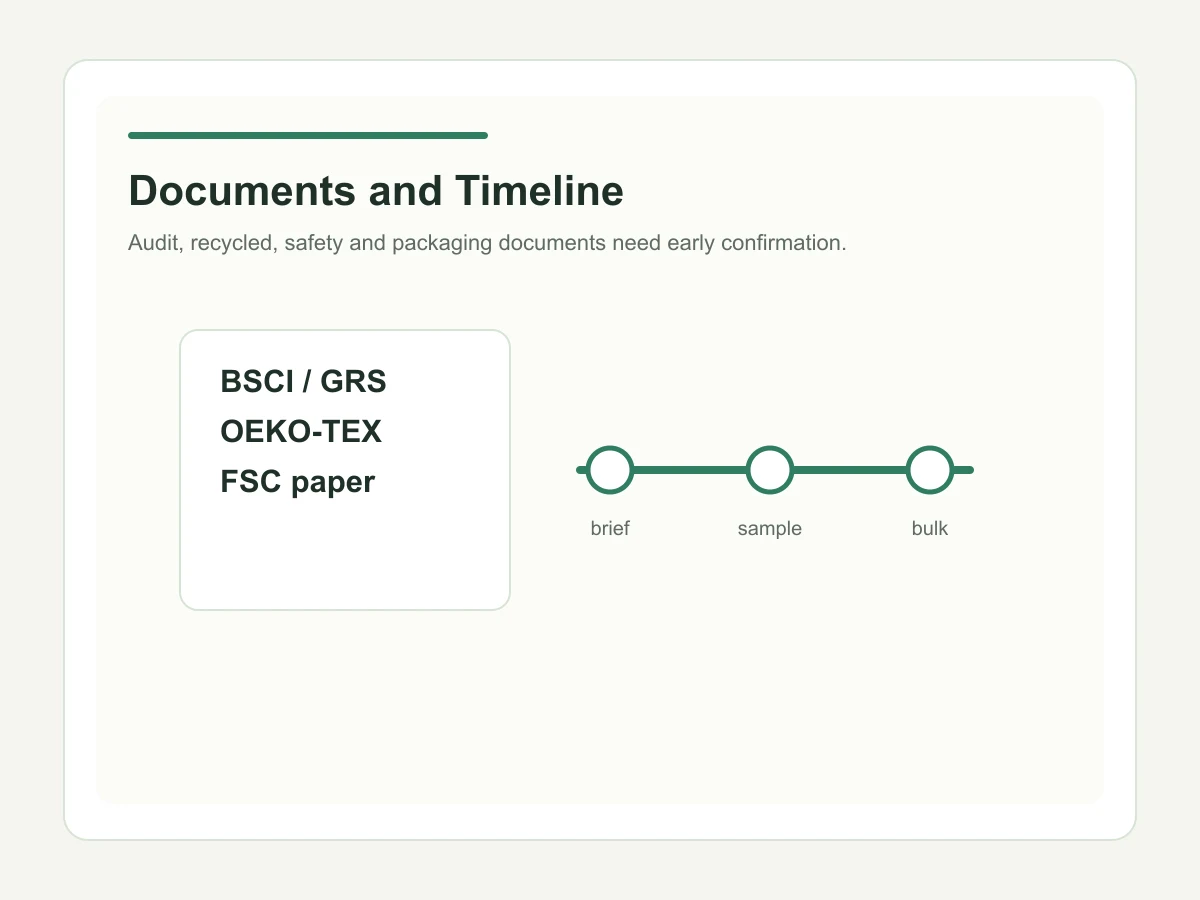
Documents must match the material, factory, order scope and customer requirement. For example, Global Recycled Standard - Textile Standards1 can be used as a recycled material standards reference when discussing recycled material verification and chain-of-custody claims, while OEKO-TEX STANDARD 100 is focused on harmful substance testing for textiles2. FSC usually applies to paper packaging, hangtags, cards and cartons rather than tote fabric4.
Environmental claims also need careful wording. The FTC Green Guides summary explains that green claims should be clear, specific and supported3. In practical RFQ terms, this means the buyer should tell the factory what claim the brand wants to make before asking which material or document can support it.
For a full document breakdown, use our sustainable tote bag documents checklist.
How Should Buyers Communicate Timeline and Launch Date?
The RFQ should include the target launch date, sample approval deadline, packing requirement and shipping destination. After sample approval, bulk timing depends on order quantity, material availability, process complexity and packaging details.
Sample timing is confirmed after the material, construction, logo method, artwork, packaging and approval scope are clear; the working schedule also depends on revision speed and current capacity. These are planning references, not fixed promises, because artwork, material and packaging details can change the work.
For bulk production, the safer wording is: after sample approval, timeline depends on order quantity, material availability, process complexity and packaging requirements. If the buyer has a retail launch, seasonal GWP or event date, that date should be shared in the first RFQ.
For retail launches or holiday GWP campaigns, starting 6-10 weeks ahead is usually more realistic. Complex material, custom color, packaging, metal hardware, certification documents or ocean shipping may need more time. Slow sample feedback directly compresses bulk production and shipment time.
What RFQ Mistakes Slow Down Custom Tote Projects?
The most common RFQ mistakes are asking only for price, sending no design file, missing size details, using low-resolution logo files, adding packaging late, adding certification requirements late, or asking for a premium result without a clear budget priority.
The biggest issue is not always whether the price is high or low. Often, the RFQ is too incomplete for the factory to judge the project correctly. Then the buyer and factory repeat the same cycle: clarify, re-quote, revise sample, adjust material, add packaging, add documents and re-check timeline.
If the budget is limited but the buyer wants a premium product, we usually help sort priorities. Maybe the tote keeps a stronger material and simpler packaging. Maybe the logo process becomes cleaner but less complex. Maybe the structure is simplified while the hangtag or woven label carries the brand feeling.
Low-resolution logos are another common issue. They can cause repeated confirmation on color, edge clarity, small text and process feasibility. A vector file at the beginning is much faster than redrawing a logo after sampling starts.
The pre-production sample also matters. If the buyer approves only photos and does not check the physical sample, the risk is higher because hand feel, thickness, structure and color can look different under different lighting. See our sample evaluation guide for the confirmation process.
Custom Tote Bag RFQ Checklist
A strong custom tote bag RFQ gives the factory enough information to recommend the right material, process, packaging and timeline. If some details are undecided, explain the project goal, target budget, use case and launch date so the factory can suggest options.
| RFQ section | What to send | If undecided |
|---|---|---|
| Quantity | Total quantity, colorways, expected reorder | Share target range and launch plan |
| Use case | GWP, retail SKU, hotel welcome tote, event gift | Explain where and how the tote will be used |
| Size | Width, height, gusset, handle drop | Send product or gift box dimensions |
| Material | rPET, recycled cotton, cotton canvas or other direction | Share budget, brand position and hand feel preference |
| Logo | AI, EPS, PDF, SVG, Pantone, logo position | Send reference artwork and desired visual effect |
| Structure | Lining, zipper, inner pocket, magnetic snap, hardware | Send function requirement and sample reference |
| Packaging | Polybag, paper card, hangtag, belly band, labels, carton mark | Share retail or warehouse requirement |
| Documents | BSCI, GRS, OEKO-TEX, FSC, testing, origin documents | Tell the supplier which market and claim you need |
| Timeline | Sample deadline, launch date, destination | Ask the factory to check a realistic schedule |
If you are not sure about material or process, send the use case, quantity, target budget and logo first. We can help narrow the material route, logo process and packaging plan before sampling.
Custom Tote Bag RFQ Brief Checklist
Before asking for a custom tote bag quote, buyers should prepare quantity, colorways, size, material direction, logo artwork, Pantone references, packaging needs, documents, destination and launch date.
- Target quantity per style and colorway
- Use case: GWP, private label, retail, hotel gift, airline gift or event tote
- Products or contents the tote needs to carry
- Preferred size, gusset and handle drop
- Material direction: rPET, recycled cotton, organic cotton, canvas or other options
- Logo artwork: AI, EPS, PDF or SVG preferred
- Pantone references or physical color sample
- Packaging: hangtag, belly band, polybag, barcode, carton marks or gift-ready packing
- Required documents: GRS, OEKO-TEX, BSCI, FSC packaging or testing reports
- Target launch date, shipping destination and delivery deadline
Less suitable fit for this RFQ route
This RFQ route is less suitable for buyers who cannot share quantity, use case, artwork, material direction, packaging needs, destination or launch timing before asking for a production quote.
It may also be less suitable for personal orders below MOQ, projects that only want a lowest-price comparison without specifications, or buyers who add certification, packaging or label requirements after the quote is approved. Ecoicolortote is a stronger fit for MOQ 500+ brand projects where the buyer wants a realistic quote, sample plan and production route instead of a rough number that changes later.
Send your quantity, size, material direction, logo file, Pantone references, packaging needs, required documents, destination and launch date. We can help check whether your brief is ready for a realistic quote and sample plan. Contact Ecoicolortote.
FAQ: Custom Tote Bag RFQ Checklist
What is the MOQ for a custom tote bag RFQ?
Ecoicolortote custom tote projects start from 500 pcs per style. Two colorways can often be discussed within a 500 pcs project depending on material, color and process setup. If the buyer needs more colors, different materials or separate packaging versions, MOQ and cost should be checked by style and production setup. This helps avoid comparing a simple one-style quote with a multi-version production plan.
Can I ask for a quote if I have not chosen material yet?
Yes. Send your use case, quantity, budget direction, brand positioning and logo artwork. We can recommend material options before sampling. If the buyer is still deciding between rPET, recycled cotton, cotton canvas or organic cotton, the factory can compare practical routes based on artwork, claim wording, handfeel and target cost. Sharing the intended sales channel also helps narrow the material route.
What logo file is best for custom tote bag production?
AI, EPS, PDF or SVG vector files are preferred. JPG and PNG files can be used for reference, but they are not ideal as final production artwork. Vector files help control small text, edge clarity, Pantone matching, embroidery conversion, screen printing setup, heat transfer output and metal plate proof approval. If only a low-resolution file is available, artwork rebuilding may add time.
Should packaging be included in the first RFQ?
Yes. Packaging, labels, barcode stickers, hangtags and carton marks can affect cost and lead time, especially for retail and private label projects. If packaging is added after the quote, the supplier may need to revise material purchasing, artwork review, packing labor, carton planning and final delivery timing. For Amazon/FBA or retail chains, label data should be checked early.
How early should I send an RFQ before a launch?
For retail launches or seasonal GWP projects, starting 6-10 weeks ahead is usually more realistic. Complex materials, packaging, documents or shipping plans may need more time. Buyers should also leave enough time for artwork review, sampling, sample feedback, bulk production, packing confirmation and international shipment. Tight schedules should be disclosed in the first message, not after quoting.
What if my RFQ is missing exact size or material?
You can still send the use case, quantity, budget direction, product dimensions, logo file and launch date. The factory can suggest a practical size, material route and sample plan before final quotation. It helps to explain what the tote must carry and whether the project needs a natural, recycled, premium or budget-sensitive direction. Product photos or box dimensions can also guide sizing.
Which document requirements should be mentioned before quoting?
Buyers should mention BSCI, GRS, OEKO-TEX, FSC paper packaging, testing reports, certificate of origin, retailer checklists and environmental claim wording before material, packaging and sample routes are locked. Document needs can affect material selection, supplier scope, lead time, testing cost, label wording and whether order-specific proof is required. Late document requests can force re-quotation or material changes.
Trademark and certification note
GRS, OEKO-TEX, FSC, amfori BSCI, GS1, FTC, Pantone and other standards, certification, organization or trademark names belong to their respective owners. This article is a buyer-side sourcing guide and does not claim that every material, product, order, package or shipment automatically carries every listed certification. Buyers should confirm current document validity, certificate scope, material coverage, claim wording and destination market requirements before quotation, sampling or bulk production.